Sunday, October 15, 2017

The colonial city of Quito in the midst of the high Andes

panorama of Quito
Quito is over 9000 feet above sea level, set in a volcanic set of valleys in the midst of the high Andes.  The city is divided by deep gorges between rivers of solid lava that once flowed from the many volcanoes surrounding the city.  Cotopaxi, which I was able to climb to the 16,200 foot level 2 years ago when it wasn't erupting, is once again very active.
Cotopaxi in the mist
The Spanish and the Incas fought over Quito for centuries.  The old colonial center shows who ultimately won, though the descendants of the Incas and other mountain people dominate the population today.
Casa Gangotena
We stayed at a superb hotel, the Casa Gangotena, right in the heart of Quito historic center.  It was once a huge palace, turned into what the management told us is the 6th best hotel in the world.  I would agree with them--it is a treasure with beautiful service.
Roses ready to pack for shipping
We spent a day in the Andean valleys outside of Quito.  Ecuador is one of the largest exporters of roses in the world.  Cultivating and exporting roses is ahead of tourism in contributing to Ecuador's economy.  So, we visited one of the rose plantations, 10,000 feet high.  This plantation employs 80 people, growing, harvesting, packing and shipping roses all over the world.  They plant roses based on what their customers want.  Asians want very long-stemmed roses; Americans do with shorter stems.  This dictates how the plants are pruned and harvested.  I talked to one of the women packing the roses who said she loves her job. It is hard work, in a huge, cold shed. 
worker packing roses
Once packed, the roses move either to the airport for air shipment around the world or to a cold room where they can be kept up to 5 days.  The older roses are sold on the streets on Ecuadorean cities, which explains why the hotels have mountains of beautiful roses filling their bedrooms and public spaces.
Unfortunately, Cotopaxi, the active volcano, was shrouded in clouds the day we were there.  It was rainy and chilly.  But, we enjoyed a walk through the nature reserve near Cotopaxi.  Even though we were at 13,000 feet, we were walking through a pine forest and vegetation and grasses up to our waists.  Very different from the alpine plants we find at 13,000 feet in Colorado.  Off to one side was a cliff falling into a very deep gorge, another show of the lava blasts that came from Cotopaxi.
walking in Cotopaxi National Park at 13,000 feet
We wandered through a busy market where most of the local people shop for their food and goods.  I was struck by the number of pigs' heads and feet that were available.  Farmers in the area raise cattle, pigs, chickens and root crops as well as roses and some grains.
Ecuador is poor.  The government has been rife with corruption.  Everyone hopes the new president will begin to deal with that, but no one is overly optimistic.  I talked to one person about health care and education.  The government provides universal health care, but it is of low quality and very slow to access unless you have an emergency.  Those who can afford to go to the private clinics do so, but this person told me her father had a medical emergency that cost $1000 in the private clinic, so her family had to borrow money to pay for his care. 
pig's head for sale in market

spectacular gold altar in historic church


women sitting outside church


Hiking through the rain forest

Hoatzin, near the lodge
We started early our first morning with a canoe ride across the beautiful black water lake that is part of the Sacha Lodge’s reserve and through a shallow channel to the Lodge’s new observation tower, rising 140 feet to the top of the forest canopy.  From this height, you can see so many gorgeously colored species of birds—toucans, macaws, hummingbirds, anis, aracaris, woodpeckers, parakeets and so many more.  The canopy is alive with birds.  Their brilliant colors flash in the sun as they crisscross the tops of the trees.  We spent almost 2 hours on the viewing platform enjoying them.  Our guides are incredible bird spotters.  They set up a telescope that they focused on particular birds so we could admire them in their colorful splendor.
toucan in the canopy

In the distance, we could hear howler monkeys calling.  In my experience, howler monkeys have, unfortunately, always been way off in the distance.  I have only seen one once, but I still love to listen to their calls.
cotinga

As we walked along the narrow forest paths, there were so many sounds.    Bumps, thumps, blops as things fell to the forest floor from somewhere above and the forest adjusted itself.  Screeches and songs and calls from birds.  Croaks, howls, rustles, slithers, barks and chirps from insects and frogs and reptiles.    It seems so quiet when you stop to listen before your ear starts to hear how noisy it really is.
Our second day, we took motorized canoes to a parrot lick, a cliff down the Napo River where parrots gather to peck away at the mineralized soil of the cliff.  This helps them clear their bodies of the toxins in some of the forest fruits they eat.  We arrived just off the cliff about 7 in the morning.  At first, there were a couple of parrots in the tops of the tallest trees above the cliff.  Pretty soon, parrots started to fly in, landing in the trees and squawking loudly with mini-skirmishes as they jostled for the favored spot on a branch.  Soon there were dozens of parrots filling the trees.
parrots and parakeets at lick
Suddenly, all the parrots left the trees at once and swarmed to their favorite place on the cliff.  Dozens of them squished into a small space, which must have had the best minerals because there was lots of other cliff area which they ignored.  Several species of parrots and parakeets busily pecked at the cliff for about 15 minutes when suddenly something scared them and off they all flew in a rush, headed back to the trees.
That night, we took a forest walk around the lodge.  While I would have loved to have seen a jaguar, they aren’t found near people, preferring to roam deeper in the forest.  The first creature we saw was a large tarantula, a nocturnal feeder.  These tarantulas have gray bodies with black legs, unlike the ones I am used to which are all black.  They are just as pcreepy, however.  They particularly like the butterflies and the butterflies’ larvae.  The lodge has a butterfly breeding enclosure, completely covered to protect the butterflies from the spiders.  But, one chrysalis happened to be on the outside of the enclosure.  We looked up to see two legs of a tarantula draped over the top of the enclosure just above the chrysalis, about to pounce on its prey.  It reminded me of a horror movie, except the spider wasn’t 6 feet tall.
lizard feeding at night
Much better than the spiders (which included a large jumping spider we photographed and quickly crept past) are the frogs and insects.  We saw one teeny frog the size of a tear drop.  Several kinds of walking sticks chomped on the huge forest leaves.  We knew the monkeys were in the tops of the trees because they were moving, but we couldn’t see them, though earlier in the day we saw little pocket monkeys about the size of a human hand.  The forest is alive at night with all kinds of life, each with its own special place in the ecosystem.
butterflies on ground in pavilion


stick bug under leav
Brown owl

wakiri poison frog
Spix's night monkey

teardrop frog


The people of the Amazon rain forest

Kechwa women showing us gourds they use for just about everything
People speaking Kechwa languages populate much of the Ecuadorean rain forest.  There are about 120,000 of them in the forest.  Other Kechwa people live in Andean villages and, of course, in Quito.
The Sacha Lodge wanted to give its guests the opportunity to learn about the forest culture while, at the same time, helping the local Kechwa tribe have a more sustainable existence.  The Lodge funded the local community to build a typical village in the forest and to help the women to develop crafts they could sell to tourists.
food cooking on traditional fire
We spent about 2 hours with 2 Kechwa women who are leaders of the local community's tourism effort.  Like most Kechwa, they are very small, less than 5 feet tall.  The older woman, 39, is pregnant with her 6th child.  She told us that when she was ready to give birth, she always had her babies at home with help only from her husband.  During her first birth, she stood up while her husband put his knee in the small of her back and pulled her shoulders backward.  Sounds grim, but she said it helped push the baby out.  Not sure who caught the baby as he emerged.  But, it must not have been an ideal delivery method, because the rest of her deliveries, also standing, have happened with her hanging onto a rope loop tied to the cross beam of her house, pushing while she hung on.  Her husband caught the baby.  Not surprisingly, she told us that younger women preferred to go to the clinic about an hour away by boat.
fish, manioc and plaintains

There are no roads in this part of the forest, except for those built by oil companies that don’t connect to anything except the river.  So, the river is their highway and the route to the clinic and to other villages.
They believe the forest provides everything they need, from natural medicines to food to materials for building their homes.   They don’t need cash, they said, because they simply go into the forest to get what they require.  But, the cash economy they have created with their crafts and meetings with tourists is clearly very important to them.  They told us the money is used to maintain the demonstration village and a small amount to buy things they need for their families. 
Their food is very limited.  Fish from the river when they can catch it, manioc and plantains are the staples.  Various larvae and bugs add to the diet, while hot peppers are a key part of the flavoring.  They make a drink out of manioc.  When they don’t have any other food, they will drink that 3 times a day.  It can be fermented to become their local beer.  They gave us samples of their food, which is quite good.  They serve their meals on large, clean banana leaves on the floor.  The family sits on the floor to eat with their hands.
eating local food

While the forest may provide for them, it certainly doesn’t provide enough all the time.  The claims that the forest is all they need are not believable when you know that child and maternal mortality are high, food is often scarce, and they really need some economic activity to make their lives more sustainable.
The villagers are all Catholics, but they add in a very large amount of traditional beliefs and rituals to their religious lives. Our guide told us that they are animists who enjoy the rituals of the Church when a priest visits them once a month.  But, the strictures of the Church do not play a big role in their daily lives.
mom, maybe grandmother and baby
The younger woman has an 8 month old baby.  She is not married and does not plan to marry.  She said she can have babies without getting married.  Her family does not mind.  They all help care for her baby.  The older woman is not married, either, though she has lived with her children's father for many years and considers him her husband.  They met when they were in school and had their first child very young, as do most couples.
Both women said they want their children to stay in their village.  Boys live with their parents or in a nearby thatched home when they marry.  Girls move to their husbands' villages.  The women said they stay in close touch with their daughters even if they are far away by forest travel time.  
Very few children have any schooling beyond about 5th or 6th grade because they would have to travel too far for secondary school and would have to live away from their families.  The is a university in Coca, but that is a long way by foot and boat from the forest communities.

Thursday, October 12, 2017

From the desert islands of the Galapagos to the rain forest of the Ecuadorean Amazon

Sacha Lodge on Lake Pilchicocha
To get from Quito to the Ecuadorean Amazon, we took the short, and much delayed, flight over the Andes from Quito to Coca, an oil town on the Napo River, one of the main tributaries of the Amazon.  This is the Ecuadorean portion of the Amazon Basin, dense with moisture, heat and vegetation.  And thousands of plant and animal species.
resident caiman

Sacha Lodge canoes


It is quite a contrast, coming from the dry, desert islands of the Galapagos to the hot and humid and dense Amazon rain forest.  The Galapagos were cool and dry; here the air is heavy with moisture and heat.  Walking through the forest, it appears that everything is growing on something else.  Huge trees support dozens of bromeliads along their trunks and branches, which in turn host other plants.  One enormous tree had another large tree growing out of its trunk high off the forest floor (we could see that because the leaves of this parasite tree were different from the host tree’s leaves). 
pygmy marmoset (pocket monkey)
Dozens of other plants were growing on the branches of the parasite tree.  Such a jumbled mass of living things.
We are staying at the Sacha Lodge, a remote collection of 26 thatched cabins, 2 hours by river from Coca.  We first took large, motorized canoes to a small cove where we disembarked and walked through the forest for half an hour to one of the river’s many sub-channels.  There, we loaded onto smaller canoes and paddled (our guides did the work) up the channel 15 minutes to a beautiful black water lake surrounded by the forest.  Here is the Sacha Lodge.  Really a peaceful and lovely setting for our 3 days in the Amazon.
cabins at Sacha Lodge

The Lodge was the dream of a Swiss entrepreneur who lived and worked in Chile, Peru and Bolivia before opening his first lodge farther up the Napo River in Ecuador.  When he was shown Lake Pilchicocha, he decided to build his second lodge here, beginning construction in 1991.  Over the years, he purchased more land and now owns 4500 acres, so has an extensive private reserve of unspoiled rain forest.
yellow-rumped cacique--a regular at the lodge
After dinner, we took a canoe around the lake and a nearby channel in search of caimans.  Fireflies sparkled in the dark forest.  We saw 2 bright red dots, the eyes of a small caiman, before we actually found the animal mostly submerged in the dark water.  This was a black caiman.  Soon after, we saw 2 more glowing eyes and found another small black caiman barely visible in its hiding place.  Apparently one caiman visits the lodge often, but we haven’t seen him yet.
agouti


Tuesday, September 26, 2017

Back to San Cristobal Island and onward

Blue-footed with tiny chick under her breast

Yesterday was our last full day in the Galapagos, a wonderland of birds, sea mammals, and reptiles.  The previous night, we were underway most of the night in order to get back to San Cristobal Island where we snorkeled off a gorgeous beach and walked on a remote part of the island.
Stately brown pelican

Here, too, are blue-footed boobies and their babies, lots of iguanas, marine turtles, brown pelicans, sea lions with their babies, and frigate birds.  Some frigate birds were mating, so we were able to see a couple of the males displaying their wares in the form of bright red, ballooning throats.  Quite a fascinating attraction.
Friendly, curious sea lions swam with us while we snorkeled, sometimes bumping their noses gently into us and leaping out of the water in graceful arcs, impressing us with their athletic abilities.  A couple of people swam with a marine turtle who was much less interested in them than they were in her.  These are very large creatures who can stay underwater up to 12 hours.  From the shore and also from the Majestic, we could see their heads bobbing up through the waves, mixing it up with the playful sea lions.  The turtles are much less interested in the sea lions than the latter are in them.

Today, we are waiting for our much-delayed flight to Coca, a town in the Amazon Basin.  More on what we do and see in the coming days.
Male frigate bird showing off his red throat


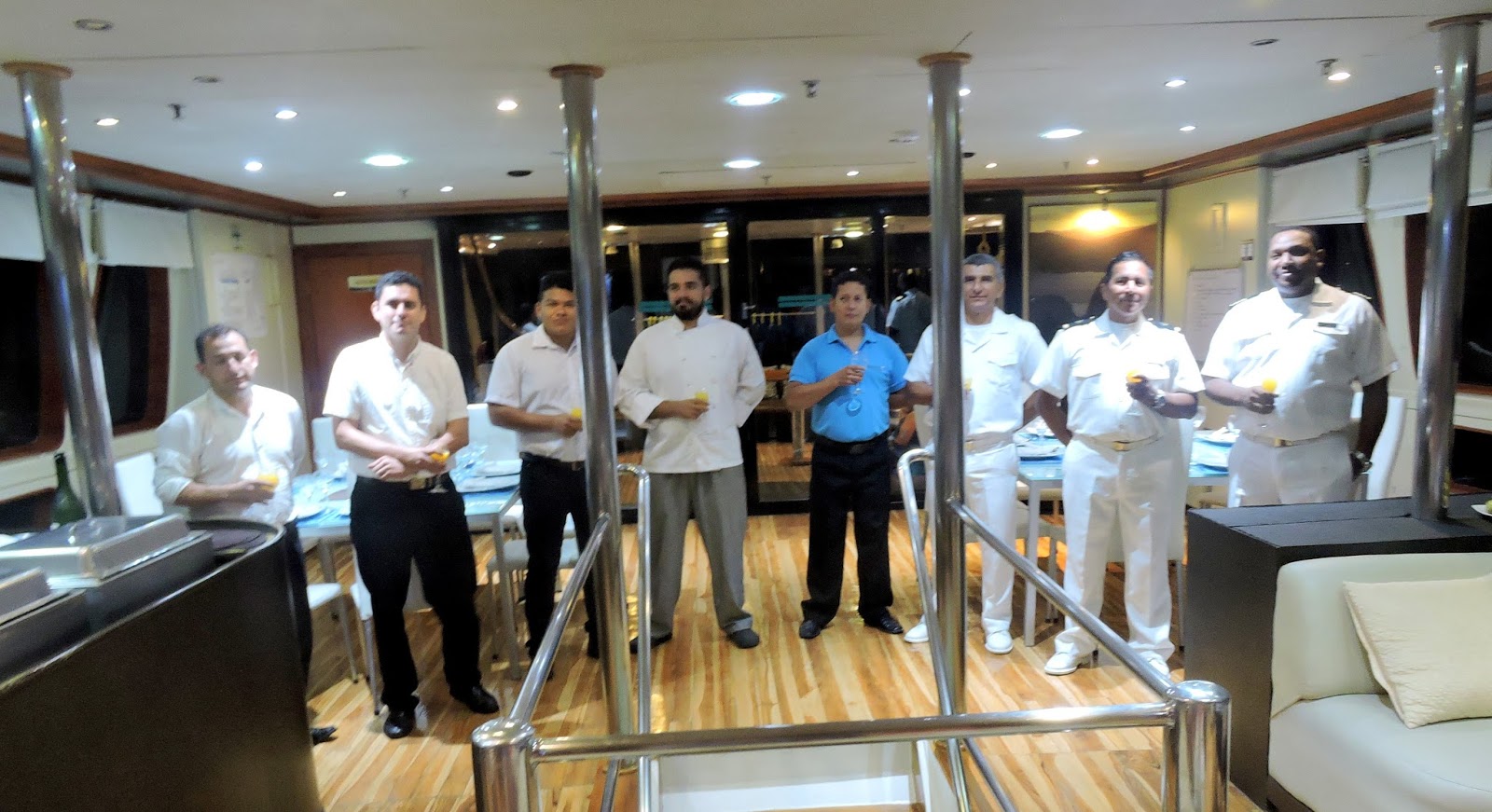
Crew of the Majestic at farewell dinner

handsome iguana headed to the ocean to eat


Rabida's large bay, great for snorkeling along the cliffs
Rabida Island is an overnight sail from Genovesa, so we arrived in the early morning at this islet, formed in the last 1.5 million years from its volcano’s huge lava flows.  Because it is relatively new, the lava is black and rough, but still home to thousands of birds and reptiles.
Rabida--turquoise cove 
We walked along a rocky red beach to a trail that curves upward to a view point and then meanders back to the beach, right by one of the prettiest coves of turquoise water and black lava I have ever seen.  On the way, we passed sea lions with their babies, blue-footed boobies diving for fish and the ever-present frigate birds eager to snatch the boobies’ catch literally out of their beaks.
sea star on beach
Lots of star fish, now called sea stars, had washed up on the beach and we learned why during our snorkel along one of Rabida’s rocky cliffs.  We saw thousands of sea stars on the sand of the shallow ledge just off the cliffs.  Several people saw sharks.  We could watch underwater as the diving boobies hit the surface and quickly grabbed one of the small fish circulating in the midst of a swarm of siblings.  They are extremely efficient in their motion, diving from a height of several hundred feet like little missiles, streamlined by plastering their wings against their bodies, pointing their beaks and necks straight down and tucking their feet.  They hit the water like Olympic divers, straight in with minimal splash, high speed and great accuracy, quickly flying straight up out of the water with, if they're lucky, their prize fish.
Blue-footed Boobies on cliff

Here, too, lives a small grey heron.  We watched one of them scouring the rocks for tiny black crabs.  When she found one, she struck like lightening, gobbling it up in just a few seconds, no doubt an adaptation that enables her to keep her own food away from the frigate birds.  Brown pelicans, American oyster catchers and the Galapagos hawk share the island with the blue-footed boobies and frigate birds, each fitting into its particular niche in this stark environment.
We moved in the afternoon to a tinier islet, Chinese Hat, which does, indeed, look a bit like a hat.  We snorkeled in a calm bay, seeing very large fish and 2 sharks.  I think this was the best snorkeling we’ve had during the trip because of the abundance of the fish and the gorgeous colors they display.  As we neared the rocks at the end of the bay, 2 Galapagos penguins watched us from their perches on the lava. 
Galapagos Gray Heron
They are thin in numbers right now due to the devastating effects of the last El Nino a couple of years ago which brought warm water to these islands, killing off the algae that the iguanas and marine turtles rely on.  Fish numbers also dropped dramatically, causing starvation among many of the bird populations including the penguins.
Late in the afternoon, we landed on Chinese Hat and followed a rocky trail along the shore.  This must be a sea lion nursery because we saw so many new mothers with their babies, including several newborns from earlier in the day.  Their faces are so sweet and they are all so unafraid of us.  Their big predators are the sharks that live in these waters.  Many sea lions have large scars on their bodies, showing a very close call with a shark.  And these are the ones that survived.
American Oyster Catcher


Several of the babies, only about 2 to 3 weeks old, lay on the rocks or sand waiting for their mothers to return from fishing far out at sea.  The mothers do not leave their babies for 2 weeks, nursing them all that time without food.  Finally, they have to eat to survive, so leave their infants for several days in order to feed themselves and be able to produce the milk the babies need.  Some of the little ones looked very skinny as they awaited their mothers’ return.  Our guide told us that within a day of having their mothers back, the babies would have round, full bellies.  But, this must be a trying time for these bewildered and patient little creatures.
Marine iguanas enjoying last sunlight

Chinese Hat just before sunset


skinny 2 week old sea lion pup awaiting mother's return from hunting


Galapagos penguin


Mother sea lion d baby