Tuesday, September 26, 2017

Genovesa, home to thousands

baby Nasca Booby on our path to the flat top of Genovesa
Genovesa, probably my favorite Galapagos island, is the nesting place for thousands of red-footed boobies, Nazca boobies, frigate birds and a variety of gulls.  Neither blue-footed boobies nor albatrosses nest here.  One has to wonder why, since all these birds fly long distances, they are so specialized in their breeding areas.
boats in Genovesa's caldera at sunset

Today, as we climbed the steps from the rocky landing site to Genovesa’s flat top covered with sharp and fractured lava, a lovely baby red-footed boobie, still covered in its white plumage, was resting right in the path, waiting for its parents to come home with food.  It tolerated the first 2 or 3 humans quite well, but became really annoyed with the rest of us, pecking at our legs with its long beak.  When we returned to our dinghies, there it still was, just as determined to block our path.
adult Red-footed Booby

The animals and birds on the Galapagos Islands have no fear of humans.  You can walk right up to any of them—no touching!—and they will neither move nor exhibit signs of alarm.  The National Park Service has laid out paths through the nesting colonies on all the islands tourists can visit, so that it appears the birds, iguanas, tortoises and lizards all know that if they are outside the path boundaries, they are safe.  They seem to feel just fine along the path anyway since many of them put their nests squarely in the way of visiting footsteps.
Although the primary nesting season is still months away, we saw dozens of baby boobies and frigate birds and some parents sitting on their eggs in their nests.  The red-footed boobies build nests of sticks in the low trees and bushes while Nazca boobies simply lay their eggs on the ground without preparation. 
Frigate bird in the air
Frigate birds also nest in the trees, usually stealing nesting material from one of the booby nests. 
Frigate birds are the thieves of the bird world here.  They get their food by taking it away from the boobies, almost always in mid-flight.  If a booby dives for fish, that motion alone will attract the frigate birds, since they know that a good booby catch is an instant meal for themselves and their offspring.  They also regularly steal nesting sticks from other nests, sometimes causing the baby to crash to the ground in the process, setting it up for certain starvation.
The Galapagos owl is found only on Genovesa Island.  We spotted two today, one far off and almost invisible on the dark lava and the other, inside a deep crack in the lava with plenty of space for a nest.  These owls eat mostly small birds, particularly the Storm Petrol, another abundant species here.

Galapagos OWL 

We snorkeled along the cliffs of Genovesa, home to gorgeously colored fish of many sizes.  The water is quite cold, so we were happy to have long wetsuits and, particularly, to occasionally find a patch of really warm water.  We didn’t swim with any turtles today, though we saw several in the deeper water.  Sea lions were sleeping along the ledges in the cliffs.  A lone Galapagos Shark joined us as it searched for its next meal.
baby ray
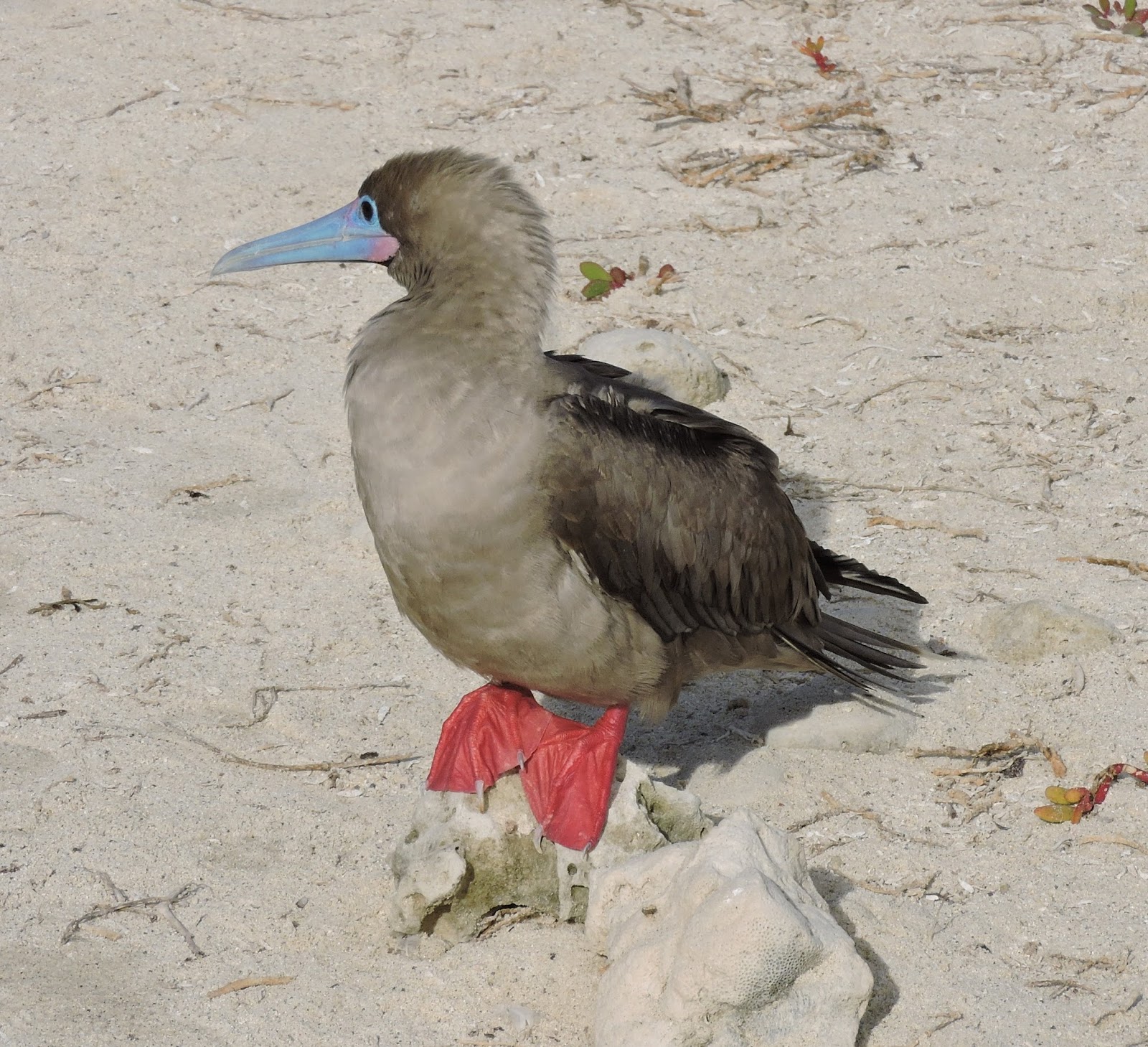
This afternoon, we walked along a beach and through a forest of red mangroves.  The trees, cliffs and skies were absolutely filled with birds.  Babies were everywhere in their white fluff.  The beaks of the baby red-footed boobies were just beginning to turn blue like their parents (red-footed boobies have bright blue beaks and bright red feet--quite stunning).  Overhead, the sky was filled with hundreds of birds, boobies trying to make it to their nests with the fish they’d caught while being chased by frigate birds intent on robbing them of their food.
In one shallow lagoon, a baby ray swam just beneath the surface while out in the deeper water, we saw a beautiful Eagle Ray, with all its iridescent blue spots across its back.
Each of these islands has its own species of birds.  Some are the only nesting places in the world for the species that come to the islands to mate and raise their young.  While the whaling and merchant ships nearly exterminated the land tortoises, and did so on many of the islands, the breeding centers are working to find tortoises with some genes from the distinct varieties each island used to host.  Eventually, these tortoises will be repatriated to the home of their ancestors, probably including Genovesa.
Nazca Booby and chick


Because we’re right on the equator, the sun sets rather quickly.  It rises and sets at just about the same time every day.  We have filled the intervening 12 hours with lots of activities, from snorkeling to walking on the islands to (some of us) kayaking.
Cactus finches are plentiful.  It was his observation of the finches, and their differentiated beaks and sizes, that so intrigued Charles Darwin and set him on the path towards his theory of evolution.  In the 1970's and 1980's, scientists studied the 13 varieties of finches in the Galapagos intensively, and wrote about the dramatic "selection events" that demonstrated evolution in several species, based on the environment of that moment in time.  See Jonathan Weiner's fascinating book, The Beak of the Finch, for a lively description of this research.
 
Cactus finch


The birds and beasts of Espaniola Island, Galapagos

baby albatross waiting for its parents to feed it
Espaniola is several hours by boat from Floreana.  Fortunately, our travel is at night so we can spend the entire day at each of the islands we’re visiting.
Espaniola beach at sunset
Espaniola is a flat-topped island, pushed upwards in several major volcanic events that occurred here.  Today, the volcanos on the eastern islands are “extinct”, but Isabela, in the western islands, has several active volcanos, extending the archipelago farther west.  We won’t visit Isabela on this trip, but were there 2 years ago and watched at night as its main volcano, the Wolf Volcano, erupted.
mother and baby sea lions sleeping
There are thousands of birds on Espaniola.  It is the only place where one species of albatrosses nests.  These birds are pelagic, finding their food in the deep ocean, not the shallower shelves and shores.  They can spend 6 months or more flying way out at sea, returning to Espaniola when it is time to mate.  Albatrosses mate for life and spend a lot of time grooming and nuzzling their mates when they get back to Espaniola.  Then, they lay one egg, cared for by both parents.
They share the island with thousands of Nasca Boobies, also with eggs and babies.  We watched some young boobies working hard at mastering their wings and getting ready to fly for the first time.
There are thousands of marine iguanas on this island, so you have to walk carefully to avoid stepping on them.  When it’s warm, they loll on the sand and rocks, often all on top of one another to generate extra warmth.  Then, when they’re hungry, off they crawl at a surprising speed to launch themselves into the ocean where they feed on the algae and mosses covering the rocks.  We watched one iguana that had gone a bit too far out to sea struggling to return to land in the midst of large waves that were pounding the rocks.  We’d see him carried forward by a wave, only to be sent back out by the backwash when the wave hit the rocks.  Eventually, he struggled onto a rock.  It is easy for these reptiles to drown if they can’t get back onto land.
Galapagos Hawk
Espaniola’s sea lions were already giving birth, though the big birth season starts in December.  We saw many baby seals, some sleeping while their mothers went off in search of food. 
baby sea lion waiting for its mom
Others were nursing while still more were merely snuggling against their moms for a little more warmth and security.
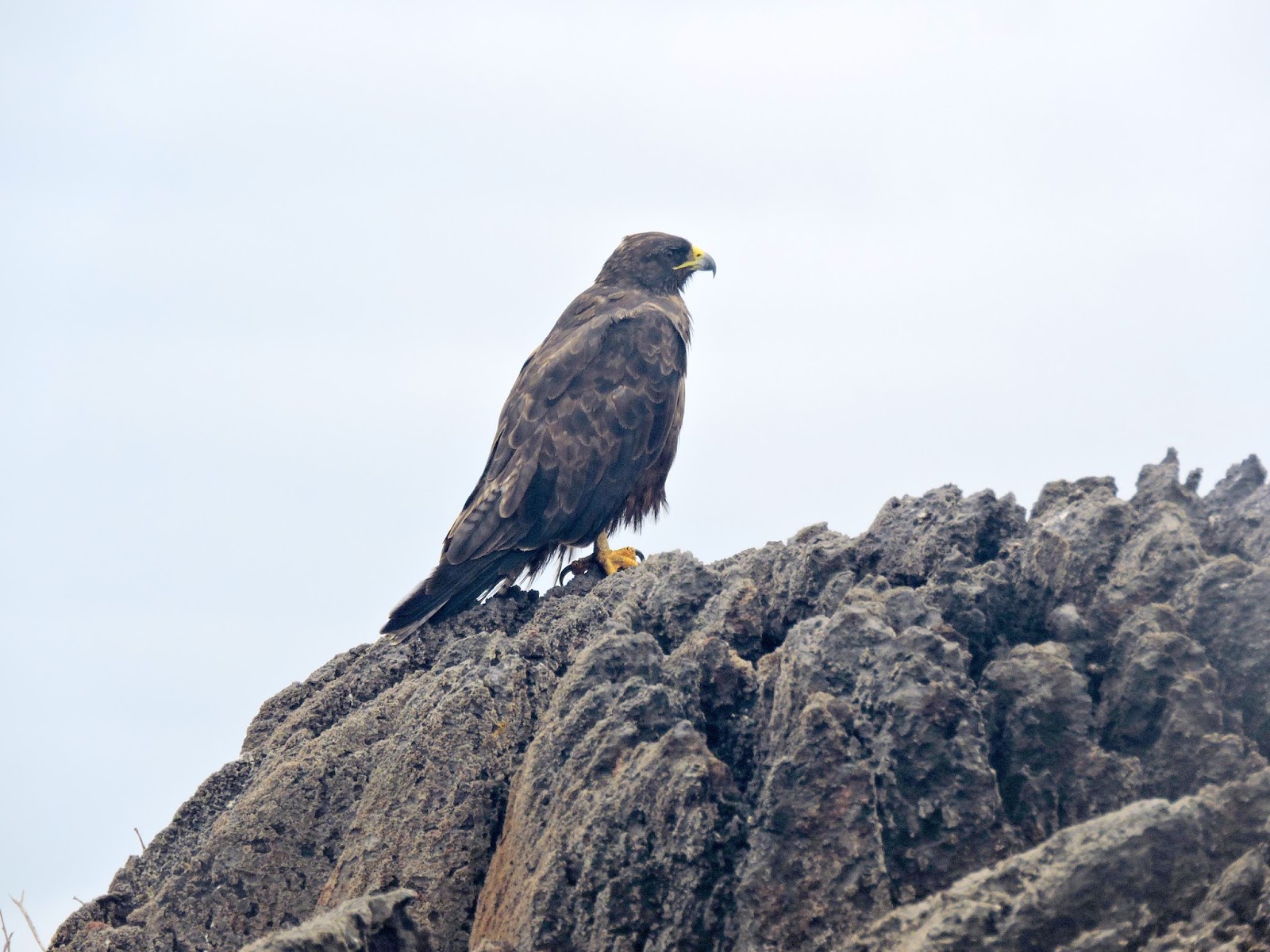
Here, too, is where we saw the Galapagos Hawk bring its baby Blue Booby to kill and share with her own babies.  Very sad to watch, but, then, the hawk babies need to eat to survive also.
Lava lizards skitter across the rocks.  Selly crabs, showing off their bright red and yellow colors, thrive on the rocks by the water, often getting deluged by a wave, but clinging to their perches nonetheless.
Espaniola also has several beautiful white sand beaches, clearly not crowded as only 120 people are allowed on the island each day.  The Galapagos National Park Service sets every itinerary of every boat and also the stringent limits on where you can go on each island.  So, the animals are unafraid of humans and no longer molested by them (as the whalers and merchant marines used to do when they stopped in the Galapagos to replenish their water and meat--giant land tortoise--supplies).
This season, there are hundreds of marine turtles in the waters around the islands.  We could see them from our zodiacs as we were heading to snorkel or walk on the islands and some of us got to swim with them (we were thrilled; they ignored us).

marine iguana pile getting warmed up

Lava Lizard
Nasca Booby preparing to fly

Selly Lightfoot Crabs


Thursday, September 21, 2017

The fascinating Galapagos--2nd time around

Blue Boobie chick, covered with burrs from the bushes nearby
We arrived in the Galapagos Sunday for our second visit, this time in winter, and with a group.  Our last visit was in June 2015, so a different season entirely.  Birds were mating; babies were hatching; the weather was hot and the water, for snorkeling, warm.
blue footed boobies in habit Floreana

In late September, the weather is cooler, much nicer for our hikes on the islands, but the water is 10 degrees colder, making snorkeling a bit shivery.  Thank goodness our boat (the same one as last time, the 16 passenger Majestic) has long wetsuits to loan us for this season.
giant marine turtle in the waves at Floreana
At this time of year, there are hundreds of marine turtles swimming in the water close to shore or feeding on the rocks just off the rocky promontories of the islands.  We have seen more turtles in 2 days, by far, than we saw in our 2 weeks in the Galapagos before.  One advantage of this time of year.
While the bird life is less abundant on the islands, there are still nesting pairs and babies.  Yesterday morning, on Espaniola Island, we watched a Galapagos Hawk snag a baby Nasca boobie, all fluffy white, kill it and feed it to its own young.  We saw albatrosses, which mate for life, nuzzling each other on the sand along with other albatrosses sitting on nests on the ground.  While one incubates the egg (they lay only 1), the other is out at sea searching for food.  If one of the pair dies before the egg hatches, the sitting mate will abandon the egg in order to feed him or herself and survive.  We saw one abandoned egg, about the size of fist.
Our snorkel today was particularly chilly, but really fun because of 3 sea lions who wanted to play with us near a high cliff.  They swam under and by us, bumping us in hopes we would chase them.  One grabbed our Zodiac with her flipper and kept trying to push it away from us.  They leaped out of the water showing us their skills and skimmed alongside us.  Sea lions are about the same size as seals, but they have external ears, which seals do no have.
sea lion heading to the ocean

Our first day here, we spent the day at Floreana Island, snorkeling twice in the cold water.  The reward was watching huge marine turtles swim just below us along with beautifully colored fish in large schools.   Several people saw a large shark that quickly swam off when he saw them approaching.
young sea lion playing in the waves
Floreana is a nesting area for the marine turtles, as are most of the beaches on these islands.  We could see the large holes the females had dug before depositing 80 to 100 eggs.  In 2 months, the eggs hatch and the babies scramble out of the sand nest, heading for the water.  They try to go at night, but even a dark cloud blocking the sun can make them think it’s time to make a break.  This attracts hundreds of birds eager to feast on these tiny creatures.  Ultimately, only about 5% of them survive their frantic rush to the sea and the months afterward until they gain enough size to be safe.

Marine turtles can live up to 150 years.  I think at least some of the ones we saw today on Espaniola were awaiting nightfall to climb up the dunes and lay their eggs.  Others were enjoying the swim in shallow water where they could feed on the algae that covers the rocks.
Today, we're in Puerto Ayora, the main town on Santa Cruz Island, so I have internet access, but the next post will probably be in about 5 days, when we are once again back in range.

our boat, the 16 passenger Majestic

Wednesday, June 28, 2017

Hiking in the rugged Pyrenees from Spain to the French Mediterranean coast


the Pyrenees from the French-Spanish border
If you want a fantastic hiking trip, head to the Spanish Pyrenees and its spectacular Ordesa and Monte Perdido National Park near Broto, Spain.  The narrow mountain road winds high up a precipitous and alarmingly steep mountain valley to a parking area leading to trails for all levels of hikers.  These are very rugged valleys with huge cliffs and jagged, rocky peaks, glacial hanging valleys and gorgeous waterfalls.
deep gorge near the Spanish-Andorran border
waterfall in Ordesa and Monte Perdido National Park, Spain
Our hotel receptionist, an avid hiker himself, had suggested we take a trail to several popular waterfalls, climbing 3000 feet in less than a mile.  That sounded a little too much like rock climbing to us (which it pretty much turns out to be), so we chose a gentler route past the many beautiful waterfalls, ending high up in a glacial valley surrounded by cliffs and filled with wildflowers, rushing water and happy cattle.
With lots of stops to enjoy the beauty, photograph the falls and nibble on our lunches, we hiked 10 miles in 6 hours, climbing about 2500 feet in the process.  The trail is an old jeep road much of the way, something the Spanish really seem to like for their hiking, changing to a more typical Alpine trail in the upper valleys.  Other trails in the Park look a bit more rugged, but not difficult.
In late June, the wildflowers are gorgeous--mountainsides of bright yellow gorse (which shouldn't be there as it's nasty, thorny and invasive, but beautiful for one short month a year), mounds of wild roses, marsh marigolds and Queen Anne's Lace, bright yellow daisies and purple delphinium. Butterflies, black, yellow, white and blue varieties, were busy enjoying the multitude of wildflowers. We saw, mostly heard, quite a variety of birds, but virtually no wild mammals, not even chipmunks or rabbits.
gorse in bloom
We stayed in Broto, Spain, a pretty town of mostly basic hotels and limited restaurants.  A little farther up the valley towards the National Park is the picturesque and charming village of Torla, which we'd recommend over Broto.  It is full of hotels, good restaurants and shops.
The following day, we headed to Andorra (more about that in another blog), over mountain roads with endless hairpin turns, harrowing cliffs off to one side or the other, and damaged road surfaces. Several times, we had to wait while road crews with huge machinery scaled the loose rocks off the cliffs above the roads and moved the resulting boulders off to one side, letting us pass one lane at a time.
cattle in the high valley
Next to a hike up a mountain in the French Pyrenees, just beyond the border with Andorra (itself a mountainous enclave in the Pyrenees between Spain and France), where heavy clouds, lightening and thunder drove us down the trail just short of the summit.
our restaurant in Torla, Spain
On their eastern side, the Pyrenees form steep ridges all the way down to the Mediterranean.  They hit the sea in rugged cliffs and deep coves all around the town where we're staying, Banyuls-sur-mer. Today, we chose a coastal hike where the climbs down into and out of coves were much more difficult than the mountain hikes we've been doing.  They're steep and rocky all the way down to turquoise water and rocky beaches so typical of the Mediterranean.
The storm clouds had been building since early morning, but no rain until we started hiking out of a small cove with a couple of beach cafes.  As we climbed to the top of the cliff, there was a rush of cold wind from off the water, so we quickly backtracked and made it to shelter on one of the cafe's covered terraces before the clouds unloaded their deluge, along with spikes of lightening and rolls of thunder.  Very dramatic.
not-so-wild horses in the French Pyrenees
Tomorrow, we'll finish our hiking week with a climb to a peak just west of Banyuls.  We can hike right from our wonderful lodging, with its 3 huge suites over a winery several blocks back from the beach, providing mountain views and great comfort.
large bull curious about hikers
Banyuls yacht harbor in thunderstorm

Mediterranean coastal hike south of Banyuls-sur-mer


USA Ultimate beach champs

sunset over Royan
Royan, France hosted the 2017 World Championships of Beach Ultimate and did it beautifully. Games were on time.  Volunteers made sure everyone knew where to go and when to be there. French security was in high presence, making us feel safe in a country that has had more than its share of terrorist attacks in the last couple of years.
huddling after the US grandmasters' team beat Spain
The USA teams were dominant, as they usually are, winning 7 of the 8 divisions against teams from 39 countries.  The men's grandmasters' team, on which my son played, won all their games by significant margins.  But, other countries are building their teams and coaching and becoming more competitive each year.  This year, the Russian women beat the USA women's team in a surprising comeback.  Ultimate has gone global and developed enthusiastic players and spectators.
Ultimate as a sport has always been based on "spirit", Ultimate-ese for outstanding sportsmanship and warm relationships with other players across the sport.  At the end of each game, both teams huddle together to tell one another what each did well.  None of the public humiliation of the losers that characterizes too many sporting events.
Ultimate action on the beach
Colleges and universities have had teams for decades.  Now high schools are sponsoring Ultimate teams.  Older players, men and women, play on club teams, many with both men and women on the team (There are mixed divisions in world Ultimate play).
It is also mostly self-refereed.  Players call fouls themselves and, if there is a disagreement about the call, the 2 players involved are supposed to work it out, which they almost always do.  They shake hands and resume play.
USA grandmasters' team entering stadium for medal ceremony
Sometimes in semi-final and final games, there will be "observers", volunteers who will intervene with a call only if the players can't come to agreement.  I think the spirit of camaraderie and good sportsmanship are key to the intense commitment players and fans have to the sport.

Tuesday, June 20, 2017

Paper or Plastic? Valerie Gordon's essay on our recent China trip

Wild Goose Pagoda, Xi'an
“Paper or plastic?” the bagger asked. 

Paper or plastic?  My mind left the supermarket in small town Nevada and I was transported across the globe.  
learning to use brush and ink at the Wild Goose Pagoda art school

Paper or plastic?  

Paper: I had seen this simple two dimensional, utilitarian yet often overlooked staple of modern life transformed into a work of art by the dancing of a brush dipped in rich pigment.  The artists in the Wild Goose Pagoda quietly and studiously brought life and meaning to the flat, white surface while we westerns watched wide eyed.  The calligraphers were neither bored nor energized as they worked their craft.  I remember watching our young, delightful guide draw simple yet extraordinary characters with the humblest of intentions.  To me, it seemed like art, beauty and meaning were pouring out of him onto the page.  Were it I who was creating the art I would have been buzzing with pride bordering on arrogance, but his face showed peaceful resignation as though his only job was to allow the ink to flow from the brush to the page in precisely the right way.  That was the paper that I contemplated as I stood in line, my groceries being bagged.

Paper or plastic?
 
potato delicacies--a favorite food in Lijiang
Another type of paper I remember with a smile.  Little, small squares of soft thin, cloth-like paper in small stacks or organized in little boxes on dinner tables.  How pointless and useless these little kerchiefs were, but how culturally informative.  Why would anyone need a paper napkin while eating?  Who would let food fall from chopsticks on the way from the dish to one’s mouth?  Who would spill food?  Food: the very essence of life--along with water and air.  Although we never experienced a shortage of it on our travels, most people in China have known tables where dishes were empty before their bellies were full.  In such a world, who would need a piece of paper to clean up what was meant for their mouths?  And yet, those who catered to us knew of our inadequacies with their prandial tools and knew that as we dropped and dripped bits of their mouthwatering dishes we would seek paper to clean up our messes.  Ironically, they had been told in decades past that we were the ones starving at home.

vegetable vendor, Suzhou
My mind moved from what type of bag my groceries would be loaded into, to the very groceries themselves.  I had a cart filled with bright, rich fruits and vegetables and yet I knew I would do them a disservice when they reached my kitchen.  How could I pretend to create anything even slightly edible after the delicacies I had enjoyed in China?  Green beans.  Yes, I had fresh, locally grown green beans in my cart, but I might as well have had canned beans because I knew that when I blanched them and perhaps even audaciously tossed them with olive oil, they would seem like card board compared to taste of the green beans we had eaten in China.  There, the beans were firm, but soft with flavors that tempted and melted the mouth.  At the tables where we ate, the eggplant, the tofu, the beef, the chicken, all the came together as part of a bigger plan.  Not only did they regale our senses, but they informed us of the different regions and ethnic cultures within China. As we shared our food, we shared our impression of the what we were seeing and learning of what we looked forward to and what we didn’t understand.  Discussions of our cultural explorations needed a safe and quiet place where we could unfold our thoughts; our private rooms with our personal culinary roulette table provided just that.  

baby panda in Chengdu
Breakfasts, of course were feasts fit for the Empress Dowager.  Once my body had been more of a reluctant fast breaker, but in China I delighted in all the options.  Of course, I enjoyed the fruit (only peeled, Gail) but missed the paper.  Again paper.  The morning paper: such a ubiquitous daily starter in the US but in China is conspicuously lacking.  When there were newspapers, I was struck by their thinness; they reminded me of the meager (if you pronounce this with a French accent you will get the double-entandre) belted waistlines of the Chinese.  The paucity of print in the periodicals was almost as laughable as the print on some of the t-shirts proudly worn as fashion not political statements.  What did people need to know?  That the belt and road initiative would be good for Asia?  That the pandas were thriving?  That an addled American had driven erratically through Times Square?  How would this change the lives of those in China?  What could they do about anything anyway?

chef carving Peking duck at multi-stared restaurant
To ground myself, I reached into my pocket.  Perhaps to touch a dry-cleaning stub, piece of round metal money, or a horse treat.  But instead of finding something that would bring me back to the present, I touch a small plastic package with delicate paper, tissue really.  A rush of warm emotion, a sense of camaraderie flushed over me.  These were of course the tissues that the XX-chromosomed ones carried when we needed to visit the ladies room.  We did so quite often with a sense of solidarity that comes from foreigners facing the reality of being in a foreign land.  Hidden behind the door, would it be a pedestal or the more minimalist, local version? Would there be paper or an empty tissue paper container?  Might someone already be occupying the private space behind the door but had left the door unlatched? It was all part of the adventure.  Sometimes we soldiered on doing our best to ignore the practically emetic fumes; staying faithfully together as though together we were invincible.  Other times we were delighted to find a truly starred lavatory experience.  Remember the decadently decorated washroom in Shanghai that addressed certain issues that would no doubt confound our Congress?  How is it that the food was so amazing but Michelin ratings seemed to have passed the restaurants by and yet the bathrooms were often referred to with galactic ratings?

rapids at Tiger Leaping Gorge
I looked up in time to see that before I could object, the chicken (bone in and skin on thanks Peter) I planned to purchase was been protected by a plastic bag.  Plastic. Plastic bags. Plastic bottles.  The fluctuating levels of the upper Yangtze River had left a foam of plastic waste along the steep cliff ravine the River had carved.  The River was more powerful than I could imagine.  I had seen it with my very own eyes yet still couldn’t conceive of its force: its hydraulic power mesmerized me as it moved from smooth water to a tumbling, building battle rolling over on itself, fighting with itself, churning itself inside and out.  To me, it seemed like the River was taunting those watching it to dare question its greatness.  Had the tiger? Had the River been angered by the Tiger’s legendary ability to leap it without batting an eye?  How could any living thing not be humbled by this; one of the greatest and simplest forces of nature doing what it simply does following the laws of physics?  

But the plastics.  The plastic foam, the detritus of human consumption lay on its bank just out of reach from the lapping water.  Occasionally small islands of bottles and bags and toys slipped into the water or ebbed out from some hidden rocky enclave and circled in on itself teasing the water.  “You can't hurt me,” it seemed to mockingly call out to the raging water.   But the River was too great, its roar too thunderous to take notice of the small insignificant pock on its majesty.  Centuries ago, the Yangtze had been a determining factor in the development of civilization in that part of the world.  In many ways, that River has contributed to the world’s economy and affected the world politically and now it is decorated with garish and sun bleached plastic.  
Tiger Leaping Gorge above the rapids


I was a contributor of course.  I chugged bottle after bottle of water everywhere we went.  I had a supersized American habit of drinking water and since I could not use a refillable container, I drank from and then disposed of plastic bottle after plastic bottle.  Did some of my consumption end up dancing in the gorge’s eddies? What is to happen with all the plastic waste?  What does it mean for a society to celebrate its history and natural resources and trash them at the same time?  How can this duality be reconciled?  How can the drive of “progress” and goal to be the world’s most super powerful power miss the basic need to keep its nest clean?  Where does this happen in our lives on US soil?

Plastic.  We were told very matter-of-factly by your delightful cousin that rice had been tainted with small pieces of plastic.   Rice in China, tainted.  Had I heard this story before I set foot in China, I would have dismissed it as a tragic piece of news in a foreign land.  An unfortunate lapse of human rights by an economic-political complex that I didn’t understand.  By the end of the trip, when I did hear the story, I felt I understood how this could happen.  I was still enraged, but felt that I could begin to understand your cousin’s “such is life in China” attitude. I had begun to understand China.  

women playing cards at Temple of Heaven, Beijing
Through our journey, I saw the sights and monuments that were on perfectly crafted itinerary.  In my daily wanderings, I saw the faces of the people in the streets, the people placidly moving with the flow of traffic on rickety bikes.  I watched their movements, their pace—always moving but somehow not in complete control of where they were going.  I watched the faces and eyes of the Chinese travelers, tourists in their own country, proud of their redacted history and of their modern-day accomplishments that show the world what they can do.  I saw the contrasts that are China, the extremes: gargantuan towers rising up from agricultural fields reaching high into the hazy air.  I saw the pencil girls costumed in Versace strolling the luxury boulevards in Chengdu while a few corners away a woman strung rags together to make a sun shield to patch her roof.  In Shangri-La, my eyes were ablaze with the colorful prayer flags as they flapped in the wind carrying prayers to the wherever the believers needed them to go and in the cities, infinite flags of colorful laundry hung prayerless against dirty sky-rise buildings.  This was the country that could plasticize rice and move on to produce self-driving cars en masse.  After all they had human assembly lines replacing potted flowers nightly along city roads and sidewalks. 
women pilgrims at Sumtsenling Monastery, Shangri La

I reached into my cart to check the label on the plastic food containers I wanted to purchase.  Made in China.  Human assembly lines turning petroleum products into everything that we touch.  We had heard about how factory workers, particularly girls had become the new economic force in China, disrupting the traditional social-economic constraints.  At what cost?  They can do anything, but what is the cost?  How could our present-day world exist without all the plastic gadgets that make life easy and inexpensive in the short term, but when will we as a world realize that this can’t continue.  When will it matter that we are making new floating continents of plastic, that sea life and now people are consuming plastic unwittingly, that our garbage pits are becoming mountain ranges. How does it end?


Sunday, June 18, 2017

Ultimate--International Championships, Royan France

Rayon's bay and beach
My son, Jim, has been an exceptional Ultimate player (Stanford, San Francisco's "Jam" club team), coach (University of Colorado team, Johnny Bravo club team) and aficionado for 25 years.  Right now, he's playing on the USA senior (called "grandmaster") Ultimate team in the international beach championships in Royan, France.  So, I'm here to watch him play.
USA team marching into stadium (Jim is 4th from the left)
Royan is on the Atlantic Coast, in the Bay of Biscay.  It was mostly destroyed by British bombs in World War II as the RAF attacked 2 German fortresses at the mouth of the Gironde Estuary.  So, there are virtually none of Rayon's historic buildings left, but its beaches are the real attraction. There are a series of bays with wide golden beaches lined with a beautiful boardwalk that continues for several miles around the bays.
USA team backed by flags of competing nations
The opening ceremony of the championships was today, very hot but quite thrilling to see the flags and teams of 39 countries march into the stadium.  France is on high security alert because of the recent terrorist attacks here and in the UK, so the boardwalk and surrounding streets and squares have roving patrols of heavily armed soldiers.
French soldiers on patrol by the beach
We are grateful for them, sweltering in all their gear and obviously watching the area with great concentration.
Last night, my first here, I walked around one of the bays about 9 p.m. as the sun was getting low in the sky.  Sunset didn't actually occur until nearly 10:00 p.m. on this close-to-the-longest day of the year.  The old stone lighthouse and the small boats in the harbor glowed with the setting sun.  Finally, a cooling breeze eased the heat of the day.  By the time I went to bed, it was going from scorching to balmy, a lovely way to end a long day of travel.
small boat harbor and lighthouse at sunset
I'm trying out my first Airbnb accommodation, a small condo with a pretty view of the bay. It's basic, but perfectly located about 2 miles from the Ultimate fields, so I can walk along the beach to get to the games.  While the town is quiet right now, despite the large numbers of tall, super-fit men and women who thrive on a tough, fast-moving sport, you can see that when summer is in full swing, the place throbs with music and activity.