Wednesday, October 9, 2019

Victoria Falls, Zimbabwe

baby elephant trying to reach our hot tub with its trunk

Victoria Falls is the 4th largest falls in the world, a long expanse of cliffs with the mighty Zambezi pounding over them.  On our last visit several years ago, there was so much water, and therefore so much mist, that we couldn’t really see the Falls from the Zambia side, where we were staying.  We were soaked as we walked the circuit along the Zambian falls, but couldn’t see much more than the water pummeling the rocks far below the top of the Falls.
Victoria Falls, Zimbabwe side
This year, the water is low because of severe drought.  We stayed on the Zimbabwean side of the Falls, at the Victoria Falls River Lodge (which we liked a lot), fortunately, since the Zimbabwean Falls had a lot of water, while the Zambian side was completely dry.
The River Lodge is in the Zambezi National Park, home to large herds of elephants as well as giraffes, antelope, many hippos languishing in pools in the river, baboons, vervet monkeys, warthogs, crocodiles and occasionally some cats, which we didn’t see there.  The tents of the camp spread out along the Zambezi, open to the animals, with separate hot tubs (cold water) for each tent.
2 males giraffes fighting

As we were about to leave for a safari drive our second afternoon, I looked through our glass door to see 4 large mother elephants and several babies drinking from our hot tub.  One tiny baby, probably only 2 months old, was trying to get its trunk into the water, but couldn’t quite reach.  It kept moving its tiny trunk around, getting within inches of the water, but finally gave up and tried to encourage its mom to let it suckle.  More elephants kept coming up from the river to drink, so we called our guide to pick us up lest we enrage one of the huge mama elephants by walking near her baby.
Sable antelope
We gathered our group in our Land Cruiser, drove to a shallow pond in the middle of the camp, and sat there watching as at least 80 elephants flowed around us, drinking, uprooting trees and moving placidly towards their next foraging spot.  It was the highlight of our animal viewing.  Just amazing to sit in the midst of these huge, intelligent animals and watch them live their lives, if only for an hour.
Later that day, we were lucky enough to spot some Sable, very large antelope that I’ve only seen once before, despite having been on many game drives over the last 10 years.  In a dry ravine, we came upon 2 young male giraffes fighting, which consists of wrapping their necks around each other and doing a lot of shoving.  It looks like a large giraffe could easily break a smaller male’s neck, and I guess that does happen, but rarely, according to our guide.
hippo resting in the Zambezi River

There is a great walk through the forest along the Falls, which we enjoyed.  It’s about 2 miles to the Falls bridge and back, with lots of points for viewing the Falls and the Zambezi River rapids below.  On our way to Kruger National Park, we walked across the bridge, entering Zambia halfway across, to take a flight from Livingstone, Zambia, to one of Kruger’s airports.  The bridge crosses a deep gorge.  Walking takes about 10 minutes, including photo stops, and is a fun way to cross the border.  Our van met us on the Zambian side with our luggage, so an easy transit.
young elephant and baby sibling
The Zambezi National Park is relatively small, so doesn’t have a lot of large predators, but we enjoyed our game drives there very much.  We have stayed at hotels on both sides of the Falls and, from now on, would always stay inside the Park at one of the tent camps along the river.  Our guide was excellent and enthusiastic, encouraging us to do longer drives to see some of the farther parts of the Park, which we really appreciated.
I do think, if you want to see lots of animals, and can only go to Africa once, East Africa (Kenya’s Masai Mara and Tanzania’s Serengeti and Ngorongoro Crater) is the place to go.  There are so many more animals there.  When I was there in August with my granddaughter, we saw up to 1000 zebras each day and many thousands of antelope, in addition to lots of lions (27 in the Crater one day alone), leopards, hippos, elephants, giraffes (I love them) and so much more.  In Southern Africa, where we’ve done safaris in Zimbabwe, Zambia, South Africa and Botswana, there are fewer tourists, but also many fewer animals.  We saw them mostly by the one’s to ten’s, compared to the dozens to thousands in East Africa.
sunset over the Zambezi

Nonetheless, there is so much to see in Southern Africa besides the game parks that it is well worth a visit. 

Johannesburg's Apartheid Museum


quote from Nelson Mandela outside Johannesburg's Apartheid Museum

If you have a short time in Johannesburg, the Apartheid Museum would be my top recommendation.  It lays out the history of apartheid and the resistance to this complete and brutal segregation of races during the middle 50 years of the 20th century.  The segregation and brutality preceded the formal structure of segregation that became codified as apartheid, and this, too, is detailed in the museum’s exhibits.
one of many such signs on display at the Museum
On our visit last week, there was a special exhibit on Nelson Mandela, still the beacon of hope for oppressed people everywhere, and the shining light of modern South Africa.  The exhibit featured his transitions from angry young man to guerrilla leader to his 27 years in harsh bondage as a political prisoner to revered leader of a reborn nation. 
Nelson Mandela's home in  Soweto
He once told his son that he would be the first black president of South Africa, long before that dream came true.  In the process of becoming that leader, Nelson Mandela transformed his own thinking, through great hardship, from hatred to forgiveness, preparing the way for him to lead the country from white rule to democracy, through the Truth and Reconciliation process, led by Bishop Tutu, to a country governed today by its black majority. 
South Africa still has many problems, including massive corruption and poverty.  People continue to vote for the African National Congress party, despite its corrupt leadership, because it was the party that led the country to freedom.  Former President, Jacob Zuma, was removed from office because of his corruption that greatly enriched him, his family and his cronies.  Meanwhile, there is hope that a new president, Cyril Ramaphosa, will help rebuild the country from its “lost decade” under Zuma. 
We also visited the Hector Peterson Memorial.  Hector was a 12 year old boy killed by police bullets n 1976 when students protested against the new law requiring all schools to teach in Afrikaans, the hated language of apartheid.  There is a museum with photos and interesting personal stories about the many children who joined the adults in fighting apartheid.
Nelson Mandela's small bedroom in Soweto home
Nearby is the house where Nelson Mandela lived briefly, now a museum also.  The street outside is a riot of energy and color, with lots of restaurants, craft shops, locals and tourists.
Everything about Nelson Mandela is celebrated in South Africa.

Thursday, September 12, 2019

With my granddaughter--Tanzania's incredible Ngorongoro Crater

view of the Ngorongoro Crater

Tanzania’s Ngorongoro Crater is one of the best places in the world to see wild animals.  It was created 2.5 million years ago when a volcano exploded violently, creating a caldera with a surface area of 200 square miles and sides that rise steeply 2000 feet above the crater floor.  The crater has many ecosystems—forest, marsh, savannah, lakes, dry lake beds, grassy hills and heavily forested upper reaches—that encourage a broad diversity of animals to live within it. 
Grants gazelles with baby
While it doesn’t have the range of antelope that you find in the Serengeti, it does have thousands of Grant’s and Thompson’s gazelles, wildebeest, and zebra, plus elephants, many hippos, lions and about 2 dozen of the desperately endangered black rhinos.  On earlier visits to the crater, I have seen cheetahs, but they seem to have moved out of the crater.  No one has seen them in several years.  The zebra, wildebeest, gazelles and hippos are permanent residents.  So are most of the other animals, but some of them roam in and out of the crater as they search for food.
Vervet monkey

Last year, my grandson and I saw 40 lions, including one pride of 15 lions, in one day.  We also saw a black rhino in the far distance.  This year, my granddaughter and I saw 22 lions and watched for nearly an hour as a black rhino approached us across the savannah from miles away, crossed in front of the 30 or more vehicles parked to photograph her, and lumbered off into the grassy plain until she became just a faraway dark speck. 
the rare black rhino--a female
We saw her early in the morning when she was quite active. 
the rhino-watchers
Dozens of animal-enthusiasts, were lined up on the dirt track later trying to get a glimpse and fuzzy photo of her, once again just a dark dot on the distant landscape.  I’ve seen black rhinos in the crater 3 times, but never this close, so it was a thrill.
This is a birdwatcher’s paradise also.  There are 430 species of birds in Kenya and Tanzania.  Many kinds of eagles, colorful kingfishers, lilac-breasted rollers (my favorite), so many different vultures.  It is always worth including bird-watching in your animal-viewing because they are beautiful and numerous.  
Martial eagle with kill

With my granddaughter--to the Mara area of the Northern Serengeti


Large crocodile on the bank of the Mara River
The central Serengeti, called the Seronera, is home to so many animals, year round.  Each of the 3 days we were there, we saw lions, cheetahs and leopards.  Elephants, giraffes, hippos, zebras, baboons and many kinds of antelope are abundant.
giraffes at sunset
We drove north from the Seronera to the Mara River area, on the border with Kenya.  In between, parts of the migration had filled the grasslands and hillsides with animals.  While we saw few zebra and wildebeest as we drove into our camp, the Mara Mara Tented Lodge, by the next morning they had come into the area along with elephants, hartebeest, Thompson’s gazelles, eland, waterbuck and giraffes, so the area began to fill up quickly.
baby hyena with mother
We drove for miles along the Mara River, hoping to see wildebeest crossing, but none of the large herds were interested in moving that day.  “The migration” is a year-round, constant movement as the animals search for greener grass.  “The crossing” is when the wildebeest decide to cross the Mara River one way or the other because they think the grazing is better on the other side.  They can go across once, or several times a day, or a couple of times a season—there is no set habit or time except that it all happens in search of green grass and better grazing.  So, climate change is causing variations in the animals’ timing because the rains may come earlier or later or not at all or last longer or shorter than usual.  This year, in Kenya, they were lasting well into the dry season.
Eland, the largest antelope

The Mara River this year was fast moving because of upstream rains.  It was about 50 to 100 yards wide, generally not too deep, but deep enough that the zebra—good swimmers—had to swim across while the wildebeest—not so good at it—had to struggle to get across.  There are crossing areas that are very rocky where the rapidly moving herd can cause some of the animals to break bones and be carried downstream to waiting crocodiles or low, sandy islands where their bodies get stuck.  Other areas are sandy, some shallow, some not.
the rarely seen, beautiful bushbuck
When a “crossing” is about to occur, a large herd gathers on one bank of the river.  Tourists gather nearby to watch.  Leaders may come down to the water over and over for hours, only to turn back for whatever reason occurs to them.  They may drift off back into the grass to graze for another day or two or a week, or one may finally decide to take the plunge and leap into the river.  At that point, the entire herd swarms into the river as well, many drowning in the melee.  You have to wonder why this same herd might decide to undertake this difficult venture again the same day or several days later. 
Meanwhile, there were a number of lions eating antelope they’d killed earlier in the day.  The stuffed male had eaten first and was asleep with his overflowing belly warming in the sun.  We watched the females ripping apart the rest of the carcass.  Whenever there is a “kill”, vultures, storks, jackals and hyenas are not far away, waiting for their turn at the remains.  A hyena will even drive off a leopard or cheetah to take over their kills before the hunters have had their fair share.
also rarely seen, beautiful reedbuck

The Mara Mara Tented Lodge has a gorgeous view over the hills nearby and valley below.  Park rangers burn the dry grass to allow new shoots to come up in the sunlight, so we watched the fires at night and did not enjoy the smoke during the day.  I think this is an archaic process that certainly contributes to global warming, but they are convinced burning adds nutrients to the soil. 
our tent at the Mara Mara Tented Lodge
In this year-old camp, the tents are quite large and luxurious.  Good food and wonderful staff, but it’s a little too polished for my taste and needs a bit more organization on logistics and training for all the staff.  There are many new camps scattered throughout the Serengeti, so there is some level of bush or luxury for all tastes.  Universally, the staffs are kind, thoughtful and very helpful.

With my granddaughter--lions, leopards and cheetahs!

cheetahs surveying the savannah

Our second day in the Serengeti was what an animal-lover and tourist can only dream of.  We began with watching a lioness resting in the tawny grass, taller than her reclining body so that she was only visible when she moved or stood up, which she soon did.
Cape buffalo mom with her baby
Next were 2 gorgeous cheetah brothers sitting atop an old termite mound surveying the savannah for a future meal.  Later in the day, we came back upon these two cheetahs when they were hunting Thompson’s gazelle, their preferred food.  They were unsuccessful in their hunt, which was disappointing since we’d hoped to watch their spectacular speed as they chased down their prey, but it was a pleasure just to watch them move through the grass so gracefully.
cheetah brothers resting after unsuccessful hunt

In the midst of the cat-watching, we looked at elephant families, full of new babies, huge giraffes, thousands of antelope, herds of Cape Buffalo, Secretary Birds prancing across the landscape and the incredibly beautiful birds, the Lilac-breasted rollers.  Hippos and crocodiles basked in the sunshine until it got too hot and they slithered back into the water (not the hippos—slithering doesn’t quite describe their lumbering, but still rather speedy, movements).
Secretary bird, named for the quills behind its head

The Serengeti is dotted with kopjes, large rock outcrops that are a haven for leopards.  We visited a kopje the day we arrived and saw a leopard hidden behind a cactus high up on the boulders.  But, this day, we watched her for over an hour as she taught her remaining cub (the other one was killed by baboons who eat anything they can get their hands on and prefer to kill baby leopards before they’re big enough to eat the baboons) to climb up the steep rocks.  The two of them perched on top of the highest pinnacle before leaping down to rest on some slabs below.  Such incredibly beautiful animals. 
the beautiful lilac-breaster roller

Later in the day, we saw many more lions—2 males with distended bellies sleeping under an acacia tree, 2 females with even more robust bellies, paws up to the sky, asleep not far from the hippo they’d killed and partially devoured earlier in the day.  My granddaughter had regretted not photographing the remaining 4 legs of a zebra killed by lions in Masai Mara, so she happily took photos of the half-eaten hippo. 
The lioness we had seen earlier in the day was off hunting when we came upon her again.  These are patient hunters, surveying their prey (a herd of Thompson’s gazelles, in this case) before slowly making their way towards the herd.  This lioness walked stealthily, stopping often, sometimes lying down in the tall grass, as she moved towards the gazelles.  Soon, the sentinels noticed her and all the gazelles stopped grazing to watch her approach. 
2 lions eating a wildebeest
It’s unusual for a lioness to hunt alone, so perhaps she had her pride nearby, but we didn’t see any help coming her way.  The nervous gazelles moved about restlessly as she circled them.  Suddenly, there was a stampede of gazelles with the lioness in their midst.  Amazingly, she didn’t get one of them.  Our guide said that lions prefer to stake out one animal and chase down that individual.  If the herd of gazelles or zebras or wildebeest all runs at once, the melee is confusing to the lion, who then has a hard time targeting one to take down.  This lioness seemed trapped in that confusion and missed her opportunity to eat. 
elephant family

Incredibly enough, at the end of the day, we found one of the few black rhinos that are kept in the Serengeti in hopes they will breed and begin to rebuild a black rhino population.  These few animals are closely monitored 24 hours a day by rangers, but are able to roam a large area of the Serengeti.  They are very difficult to find, partly because there are so few of them, partly because the Serengeti is so big, but mainly because they tend to hide if they think anyone or anything is watching them.  This rhino spent most of her time in the deep grass in a river bottom, but we were able to watch her walking through the reeds several times and to clearly see her 2 horns and enormous body (grey, not black).  What a thrill to actually see one of these rare and weird animals.
black rhino (this one in the Ngorongoro Crater)

White rhinos are actually darker than the black ones.  Their name is derived from the Masai word, weit, meaning square lips.  The white rhino’s head is long and looks a bit like a ski jump, with a rectangular mouth that aids its grazing.  The black rhino is really gray and has a shorter head, more pointed, with a rounder mouth better designed for browsing on bushes and low trees.  Both have 2 horns.
hippos sunning themselves


With my granddaughter--Masai Mara to the Serengeti

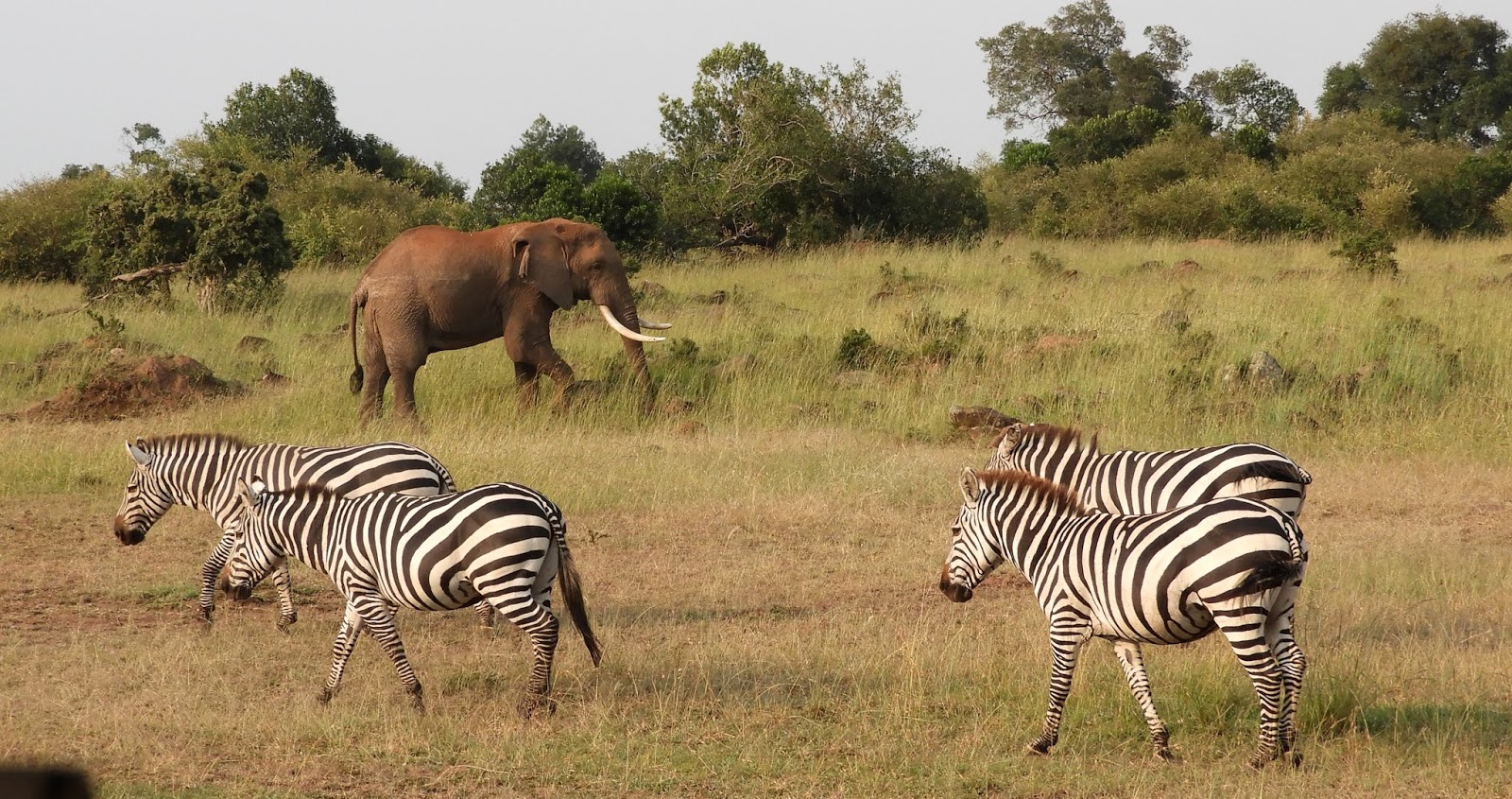
zebras and elephant at sunset

As my granddaughter and I drove to the air strip near Karen Blixen Camp in Kenya's Masai Mara Reserve, we saw literally thousands of zebra, more than I have ever seen before.  Babies were abundant, so, if the next rainy season is good, there will be many thousands more.  I think we saw at least 10,000 zebra during our 3 days in Masai Mara, stretching as far as the eye could see in massive herds.  The wildebeest with them also number in the many thousands, probably at least as many of them as zebra.  
herd of wildebeest
Instead of flying back to Nairobi, we took a bush plane to a town in Western Kenya where a bus met us to drive to the border between Kenya and Tanzania.  The driver shepherded us through customs and immigration on both sides of the border, a process that took about an hour.  From the border, we drove another 10 minutes to the Tarime airstrip in Tanzania where our bush plane to the Serengeti’s Seronera airstrip awaited us.  This is a much better route than flying or driving back to Nairobi, then flying to Kilimanjaro Airport in Tanzania where clearing customs can mean long lines, before flying on to one of the Serengeti airstrips.  
our plane to the Seronera

It’s very easy to fly around East Africa.  The airlines are set up to manage multiple landings at the many airstrips all over Kenya and Tanzania.  The flight departures and arrivals depend on how many people are going where and how many airstrips each flight must visit.  It’s quite a logistical marvel.  The airlines notify each passenger’s travel agency and camp the night before a departure to let them (and you) know what time to be at the airstrip.  Since there is no customs or security, the plane merely lands, loads you and your luggage—small bags only—and takes off.  The pilots are excellent since they take off and land on dirt or grass runways many times a day.  They can find a tiny airstrip in the midst of the large savannah or forest, distinguish it from dozens of others that look just like it, and deposit you where you need to go.
Since the majority of the zebra and wildebeest had already moved north by late July, the remaining animals in the central Serengeti (Seronera area) had a little more space and grass. 
Thompson's gazelle
I have never seen as many of the beautiful, small Thompson’s gazelles as we did our first afternoon.  We watched a lioness eat a Thompson’s gazelle deep inside a bush, perhaps hiding it from the rest of her pride, and a large male lion snoozing under an acacia tree.  We finally found our leopard, beautifully camouflaged beneath an aloe vera cactus high up on a rock, sleeping off her recent meal.
View from Asanja Moru tented camp
Our first camp in Tanzania was Asanja Africa Moru Tented Camp, far out in the bush in the central Serengeti.  This is much more rustic than Karen Blixen, but still quite luxurious, given its location.  They have to haul their water from Seronera, so work hard to conserve water.  Their electricity is all solar.  The large tents face the golden hillside covered with acacias and wide open to any animal that wanders by.  At night, as in most camps, you need an escort to go to and from dinner in the main lodge, which is also open to the savannah and the stars.  There are no noises except the sounds of the animals and the wind blowing the canvas flaps of the tents.  As with most tented camps (which I much refer to the lodges and hotels), there are no windows, just large screened openings with flaps that can be lowered at night, via zippers, if it’s cold.  The entrance also zips and has canvas flaps.  A curtain separates the bathroom from the sleeping area which has large, comfortable beds and soft fleece robes.  

can you find the leopard sleeping behind the aloe vera?
I have always seen leopards in the Seronera area of the Serengeti and this time was no different.  More on these beautiful cats in my next blog.


Wednesday, September 11, 2019

Nairobi's great places for kids

Sheldrick's elephant orphanage--this 1 year old LOVED the mud
Last year, I took my 10-year-old grandson to East Africa, Kenya and Tanzania, so he could learn about a different part of the world than his California and, now, North Carolina homes and see the magnificent animals that populate the East African savannah.
baby eager for its bottle of formula
This summer, I was back in Kenya with my 9-year-old granddaughter for the same reasons.  We spent 2 days in Nairobi, visiting Sheldrick’s Elephant Orphanage, where orphaned and often injured baby elephants are cared for until they are slowly introduced back into the wild.  This is a highlight for any child, watching the keepers feed enormous bottles of baby formula to the eager babies (up to 3 years of age) and the babies’ frolics in the mud bath that is maintained for their play (the mud also keeps them cool in the heat of summer).
feeding the babies at Sheldrick's
Most of the babies have been found in one of Kenya’s many game reserves, wandering alone.  An elephant herd will try to protect an orphaned baby, but no other female will feed it, so unless it has learned to eat grass and foliage, it will starve.  Sheldrick’s has found that regular baby formula works best for these huge infants.  Slowly, they learn to eat leaves and grass.  When they are 3 and healthy, they are taken to Sheldrick’s sanctuary in one of the reserves and reintroduced to wild elephant life over 5 years.  They gradually go out to meet elephant herds until one admits the young elephant into its family life.  At that point, they are self-sufficient in the midst of the herd and wild once again. 
We also visited the Bomas, an outdoor museum with typical homes and enclosures used by most of Kenya’s tribes.  Some are thatched huts and others are mud and thatch.  There are about 20 different enclosures that show how people live in the countryside.  Both my grandchildren loved ducking into the huts and exploring the different ways people build houses.
a family compound at the Bomas, Nairobi
There is also a cultural performance showing a variety of tribal dances.  Almost all the visitors are Kenyan school children, dressed in their various uniforms and enchanted with one another.  Last year, the program ended with exceptional Masai dancing, which features incredible jumping by the men, and a superb acrobatic exhibition.  This year, the Masai dancing was lackluster and there were no acrobats.  I would not recommend this cultural show as it was very disappointing this year, though I do think the Bomas are worth a visit.
There is also a giraffe sanctuary, which you must visit mid-day when they're feeding the rescued giraffes and several museums.  For kids, a shorter day is better because they (and you) will be tired after a long trip.
Sheldrick's babies at play