Saturday, October 28, 2017

Iran's northern city of Tabriz and the nearby troglodyte village of Kandovan


Kandovan, a cave village south of Tabriz
Tabriz is a desert city, formerly a major stopping point on the ancient Silk Road, and today an industrial city framed by rocky red mountains.  People here speak Turkish as their primary language, though most speak Farsi as well.  There is an incredible amount of new construction, mostly of housing.  New cities are being built, complete with huge apartment blocks, shopping areas, schools, parks and clinics.  But, there are also still the old mud brick sections of the city, with narrow, windy streets, that remind everyone of its past.
interior archway of Blue Mosque

Tabriz bazaar gold section


Tabriz has a very large bazaar listed as a UNESCO World Heritage Site.  Like most Middle Eastern bazaars, the shops are tiny and organized in sections—gold jewelry shops in a long line along one alleyway, carpet shops in larger spaces surrounding a courtyard, an endless variety of inexpensive clothes and household goods in their particular areas.  People come to the bazaar expecting to get cheap goods.  As everywhere, people stopped us to ask where we were from.  Don bored some women with videos of his new granddaughter.
Don showing women videos of his granddaughter
If Iranians want something pricey, they go to one of the new malls.  In fact, our hotel, the newest in the city and very good, is attached to a shiny new mall full of high end shops and packed with shoppers at 10 p.m. on Thursday night.
new high end shopping mall

The old Blue Mosque is a relic of Tabriz’ glorious past.  It was destroyed by an earthquake in 1779.  The dome and many pillars continued to stand for another century, but without any attempt at renovation, the dome, too, collapsed from neglect.  The mosque has been rebuilt and very partially restored, showing the beauty of its deep blue tiles.  It must have been spectacular in its previous life.
ancient wine vessel at Azerbaijan Museum

Next door is the Azerbaijan Museum, with a wonderful collection of artifacts dating back 4000 to 5000 years.  There is beautiful pottery, alabaster carvings, obsidian arrowheads and an Iron Age grave.  The basement is dedicated to a modern sculptor whose large and fascinating sculptures depict the miseries of humankind, all brought on ourselves by ourselves.  It is social commentary in a very interesting form.
We were sightseeing on Friday, the Muslim holy day, so the city was quiet in the morning, empty of traffic until about noon.  We wandered by the Friday Mosque, a monumental 10 year old complex that is a center of religious and social activity on Fridays.  The Red Crescent conducts health screenings every Friday to check people for diabetes, heart disease and other chronic ailments.  There are separate tents for women and men, both very crowded. 
women waiting for health screening at Friday mosque
In the afternoon, we drove to Kandovan, a troglodyte village south of Tabriz.  This entire area is volcanic and, in Kondovan, resulted in a mountainside of inverted volcanic cones that the local people carved into their homes.  While many are still homes today, some have been turned into shops which are reachable by climbing up steep steps from the valley below.  Local farmers still use donkeys to haul their produce to the village markets.  We stayed in a cave hotel that had some charm, but not much else to recommend it.  To get to our room, we climbed up about 9 stories of steep steps.  Our luggage was hauled up from below in a wooden box attached to a long rope on a pulley.  We enjoyed the town which, at about 8000 feet above sea level, is cool right now and downright frigid in the winter.  We were quite an oddity to the villagers and Iranian tourists who stopped us to take photos of us and to welcome us to Iran.
Kurdish tourists in Kandovan who wanted photo with us


Kandovan donkeys


Thursday, October 26, 2017

from Iran's Caspian Sea to the Safi Mausoleum in Ardabil

GS with young Iranian women at Sheikh Sazfi Mausoleum, Ardabil
We walked on the none too clean beach along the Caspian Sea for a while yesterday morning.  People, including women in their chadors thrown over tight pants, were running and walking by the water.  The Caspian is huge and shallow along its shores, with small waves.  Several of the walkers came up to talk to us to find out where we were from.  One took a liking to Don, despite communicating only in Persian, and wanted his photo to keep the moment alive.  The dog is one of the many friendless creatures roaming the beaches and towns for food, but, at this moment, at least, it seemed peaceful.
Don with new friend and  dog on Caspian Sea beach
In the Anzali fish market later, Don inspected the day's catch.  I am not as excited about looking at dead and dying fish.  I would prefer that they be quickly put out of their suffering, which doesn't happen, and kept on ice, which also doesn't happen.
fishmonger with GS and fish
One lady came charging out from behind her fish stand (a metal table covered with various kinds of fish warming in the sun), pinched my cheek, delivered a huge kiss on my other cheek, and gave me a big hug.  Then she went back to her fish and pulled one out to showcase a photo of the 2 of us.  She spoke no English, but her welcome and laughter couldn't have been more clear.
Caspian Sea beach
melons at the Anzali market
There were piles of huge melons in the market, truckloads of onions and tomatoes, giant cauliflowers and 18 inch long celery.  I don't know how one chooses her particular shop for the day's shopping, but the women of the town seem to know just where they want to go.
Rice is a major crop along this coast.  We stopped at a rice factory to see how the rice is processed.  First it is dumped into long bins about a foot deep.  These are heated while the rice is stirred to prepare it for the dehusking machines. 
rice bins
Next it is run through machines that separate the husk from the kernel of rice.  And after that, the kernel goes through a polishing machine to remove the "skin", what makes brown rice brown rice.  Finally, it passes over a sieve that separates the smaller kernels, the inferior rice, from the larger kernels, the more desirable and expensive rice.  Iranians are just beginning to eat brown rice for its extra mineral and vitamin content.
We drove along the Caspian most of the day, sometimes by the water and sometimes a kilometer or less away. 
roadside tea shop in alder forest
At one point, we stopped for "forest" tea, where an enterprising man had set up a little tea stand at a clearing to offer tea to passersby.  We decided to walk from there the 3 or 4 kilometers to the next beach, through a beautiful alder forest.  Next to a small lake was the perfect billboard (see below), pointing out that destroying the environment was destroying the earth.  I wish more Iranians would worry about that.  Trash is so pervasive that it just becomes part of the landscape.  The counter, however, is the beautiful gardens and parks the Iranians treasure.
enviro billboard
valley between Iran and Azerbaijan

For about 40 kilometers, we drove along the mountainous border with Azerbaijan.  The northern part of Iran is populated by Azeris and the area is called Western and Eastern Azerbaijan.  There is a barbed wire and razorwire fence demarcating the border, which runs right along the road for part of its length.
In Ardabil, the key attraction is the Sheikh Safi Mausoleum, a beautifully designed and tiled complex of towers, courtyards and graves.  Quite a few women came up to us to have photos taken with us.  One group of gorgeous young women spoke English, so we chatted about their jobs for a while before taking our photos.
The Sheikh Safi Mausoleum has beautiful tiled facades and arched doorways.  Inside, the main dome is painted in gold leaf.  The tower where the Sheikh is buried was lovely in the evening light.  Two new minarets stood out against the crescent moon.


Sheikh Safi's tower tomb

tiled courtyard at Sheikh Safi Mausoleum

minarets and the moon

tiled doorways at Safi Mausoleum, Ardabil

gold dome of Sheikh Safi's tomb

Northern Iran--a day of wonderful surprises

Mt. Sabalon, Iran's 3rd highest mountain and a quiet volcano
What a fascinating day!  We left our dismal hotel in Ardabil (the Sabalon--I won't document it's deficiencies because you can read all about them in TripAdvisor's reviews) to drive to Tabriz, across the Agorz Mountains and the high plateau of Eastern Azerbaijan Province.  This area is populated by Azeri farmers who live in mud brick villages (with some newer homes of concrete, much less picturesque and, I'm sure, much more comfortable than the mud brick buildings).  It is a volcanic area with Iran's 3rd highest peak, Mt. Sabalon, towering over the plain.
village house with hay on roof and cowpies nearby for fuel
The farmers bale the chaff from their wheat into hay to feed their animals in the winter.  To keep it dry in this harsh climate, they pile the bales on their roofs, which also serves as insulation in the cold months, before the sheep and cattle consume it.  Quite a creative solution to 3 problems, hay storage, insulation and feed for animals.
village men with our driver, Ali

We left the highway to drive along a rutted track into one of the villages so I could photograph the hay on the roofs.  It turned out to be much more interesting than just a couple of photo opportunities.  As I keep saying, everywhere we go in Iran, people are so welcoming.  In this village, the men wanted me to photograph them with our gregarious driver, Ali.  They shook our hands and said, "welcome to Iran" over and over.
village women outside house


The village is mostly crumbly mud brick houses with a shiny mosque and some large concrete houses built recently by the more wealthy farmers.  The women make patties out of the cow dung, just like women in India do, for fuel.  It works, but it's pretty fragrant.  Outside the homes are huge piles of dried cow patties.
Here the women don't wear the chador.  They wear long skirts with blouses and jackets and head scarves.  Instead of black, they wear colors.  As we walked around the village, we found a truck parked near the mosque, full of clothes, food and other household items.  The merchant travels between villages, parks and sells his goods.  Some of the village women were there inspecting his wares.
woman at itinerant shop
The farmers harvest their wheat by hand and haul it to one of many threshers spread out across the plain.  The threshers are stationary.  The grain comes out a chute at one end, while the chaff falls to the ground and is raked up to bale into hay.
Farther along the highway, we found a very large animal market in progress.  We have seen these markets in Kashgar, in far western China, and in western Kyrgyzstan.  The Kashgar market is a major tourist attraction for those who venture into that part of Xinjiang Province, along the ancient Silk Road.  This market was just as large--and completely unknown outside this area. 
Bahreman Thursday animal market


This market is mostly a cattle market, but there were sheep also.  In another large area, men sold everything from wrenches to saddles.  Other men cooked hot meals for the buyers and sellers.  I was the only woman among the several thousand people there.
buffalo cow and calf
This is not animal heaven.  Calves are separated from their mothers way too early, so some of the cows were dripping milk from their udders because they needed to have their calves nurse.  Animals are loaded and unloaded into the backs of trucks with no regard for the bumps and bruises they receive in the process.  They are packed in as tightly as the new owner can manage.  Everyone in the vicinity comes over to help load the small trucks.
loading calf into truck
Besides cattle, there were quite a few buffalo and even one pathetic little donkey trying to get away from the large cow it was tied to and a horse high up in a truck with no loading ramp.  Can't imagine how it got up there.  There is also a produce market where men were selling vegetables including huge squash, kohlrabi, tomatoes, onions and potatoes.
In the animal area, men were haggling over the price of the animals they were buying and selling.  Others were counting money.  Some were sitting on the ground talking.  Clearly this is a major weekly event, on Thursdays, the day before the Muslim holy day of Friday.  In Iran, the weekend is Thursday and Friday.
sheep market
counting money at Bahreman market
We stopped for lunch at a town a little farther


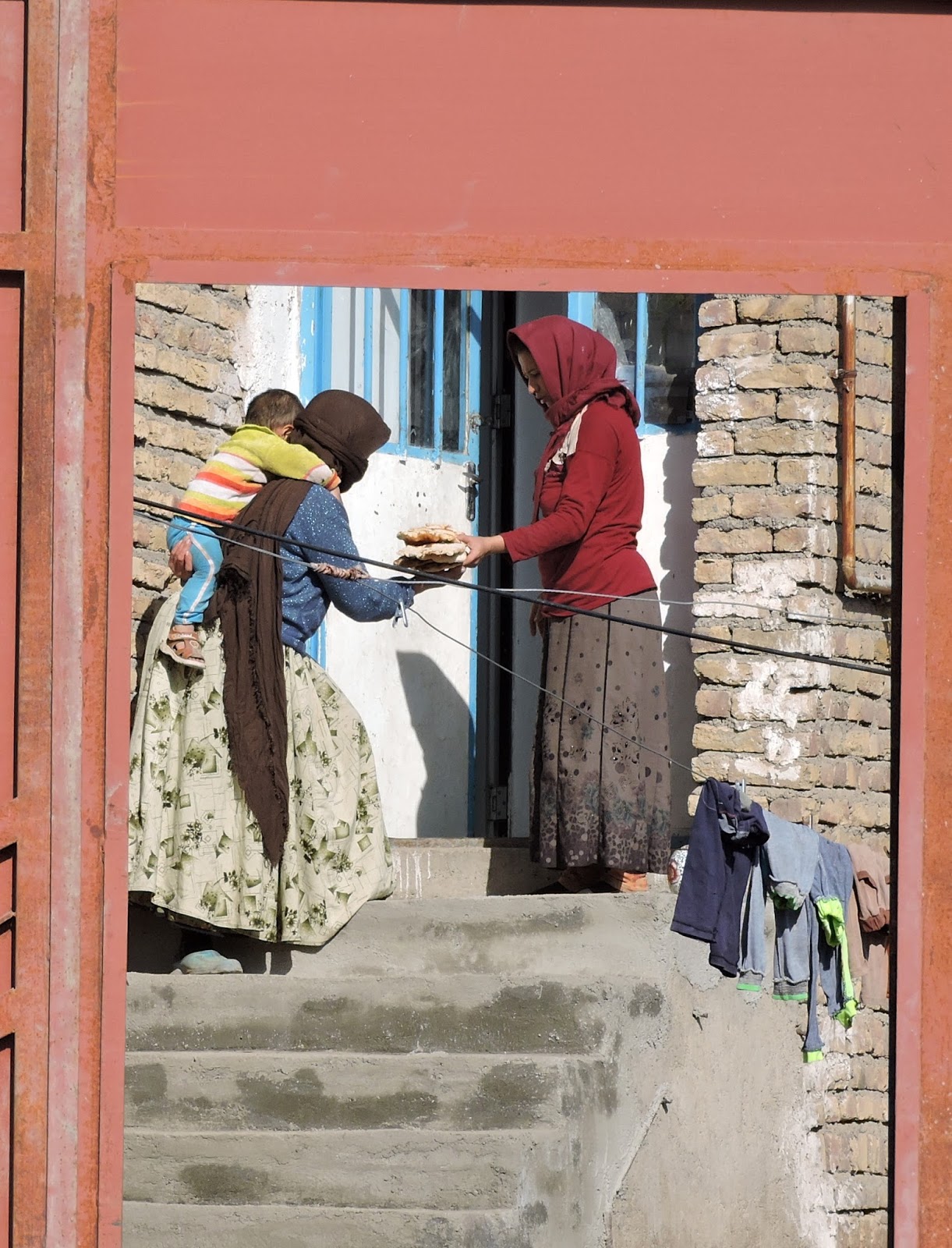
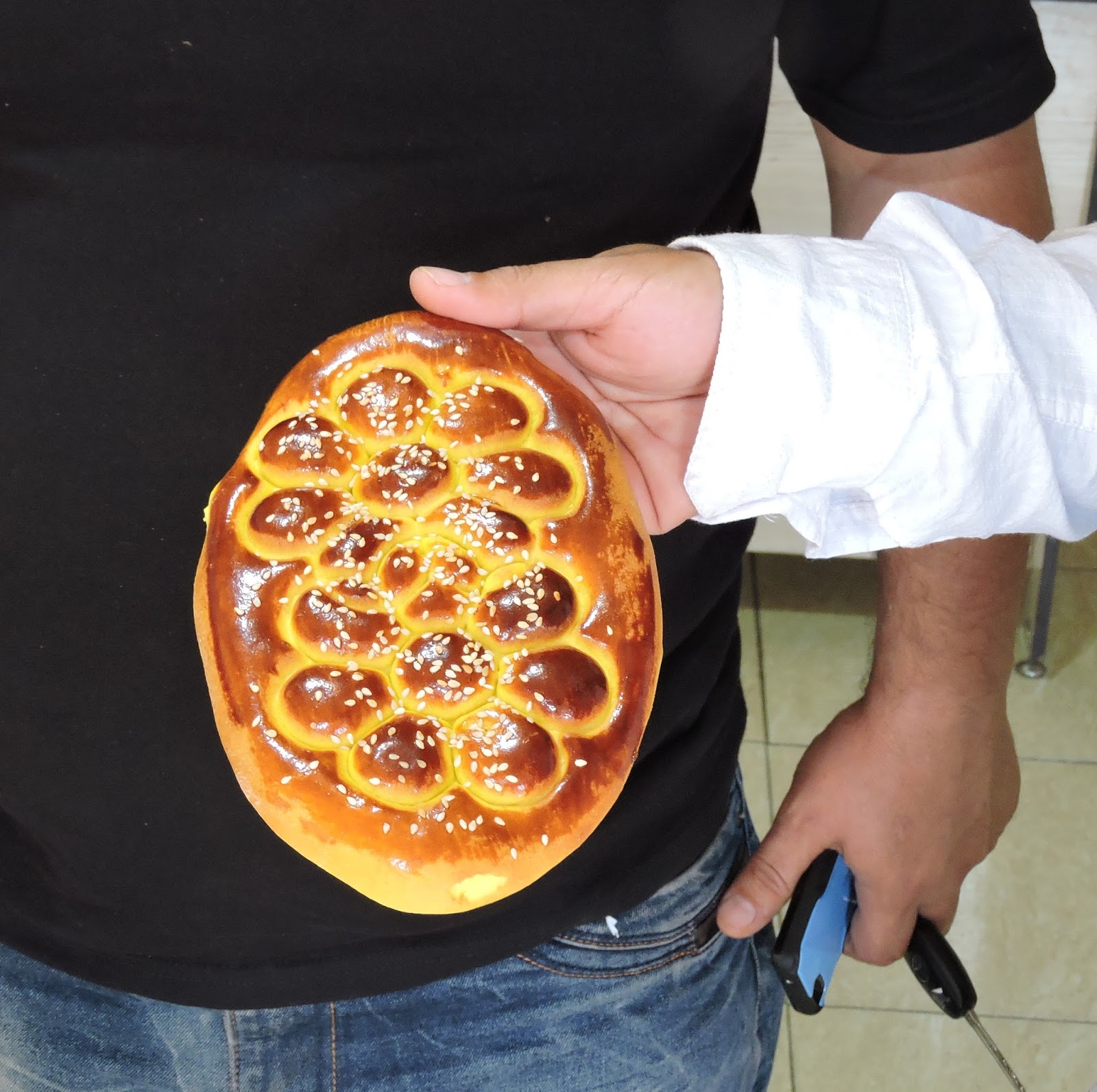
up the highway.  We've found the roadside restaurants are very good.  The menu is not varied, but the food is delicious.  I particularly love the homemade yoghurt.  These restaurants are all family-owned and everyone in the family participates in some way.  Next door was a bakery.  We walked in to see the local bread and left with 4 loaves of bread.  The owner wouldn't take our money.  It was his gift to us.


local bread


car parts for sale at Bahreman market


Iran's Caspian Sea

Heron and egret in Anzali's lagoon
Tea is a staple of the Iranian economy and diet.  Since alcohol is not permitted in Iran, tea is the customary beverage to share with friends, family and guests.  We are offered tea wherever we go. 
mountain of tea waiting to be bagged
Our driver stops periodically to offer us tea or, his preference, very strong Turkish coffee, which he brews in a tiny pot over an equally tiny gas burner inside the car as we pause on the side of the road.
We visited a tea factory this morning on our way to Anzali, Iran’s largest Caspian Sea port.  The harvest is over right how, but mountains of tea remain to be shipped to Iranian and world, mostly Indian, markets.  The manager enthusiastically guided us around the plant, explaining the tea-making process. 
having tea at the tea factory
He was so excited to have 2 Americans visiting that he called the owner, who lived in Florida for many years and is now living in Iran again.  The owner offered to come meet us, but we had to be on our way.  So, the manager invited us to have tea with him.  He ran over to his battered pickup, opened the tailgate, ordered tea through a window in one of the buildings, and served us tea from the back of the pickup.
When the tea first comes to the factory, farmers unload it on a large platform, weigh it, and receive payment.  The fresh leaves move to ovens that heat them to remove some of the moisture (20 minutes) and then to a machine that crushes them lightly before dumping them into wheelbarrows to be taken to a second room where they are spread out over the floor, 10 centimeters deep, to oxygenate for 2 hours and 45 minutes.  From there, they go to a series of rotating racks in drying ovens for another 20 minutes before being moved to a huge room upstairs where they are spread, via conveyor belt, over burlap  placed across large mesh-covered bins.  For the next 12 to 16 hours, hot air blows underneath the burlap in the 4 foot deep bins while workers constantly rake the tea leaves in order to dry them evenly.
tea fields and Agorz Mountains
Next the leaves go to sorters which both remove any remaining stems and debris and, through sieves, sort the leaves by size.  Finally, the tea is dumped in huge mounds onto the floor (not excessively clean) and shoveled into large bags for shipment.  Big piles of tea dust and debris remain beneath the sorting machines.  This is eventually returned to the fields as fertilizer.  About 25% of the volume of the fresh leaves eventually becomes tea.
The machinery is very old.  I’m sure the sanctions have made it difficult to replace the equipment.  But it also seems to be adequate to the job, though it could use a thorough scrubbing. 
The city of Rascht, with 1.2 million people, is the capital of Guilan Province and has a busy central bazaar.  We strolled through the produce, fish and meat stalls.  Once again, the merchants were so kind.  They offered us tea, bites of cheese, tastes of radishes and questions about the US and Trump.  They liken Trump to their former president, Ahmadinejad, who they think was crazy and a terrible president.
making pastries in  Rascht bazaar
posing with beautiful women in Rascht

The city of Bandar Anzali spreads along the Caspian Sea.  It’s primary economic driver is its port.  Along the water, not far from the cranes, are some large villas, but there are many more small bungalows and dingy apartment buildings.  The town looks like it has had boom and bust cycles to match Iran’s economic roller coaster.  Over the years, salt water from the Sea has inundated the coastal farmlands.  Now, there is a large swamp that is brackish, where once fields and farmhouses stood.  Cattails and muck like quicksand have replaced the farms, but the marsh is nirvana for birds and, I’m sure, many small animals. 
swamp just before sunset
Shortly before sunset, we took a speedboat through some of the channels, lined by tall marsh grasses, to a lagoon.  Herons and egrets flew off as we approached, and the sky filled with seagulls looking for a free lunch. 
There is a Christian cemetery in Anzali.  It has a section for Armenian Orthodox graves (there is still a very small community of Armenians in Anzali) and another for the sad remnants of a small and desperate Polish migration to Iran in 1941.  Some of the Poles were fleeing the Nazis, some had escaped from Nazi POW camps, others had fled Soviet gulags.  They ended up in Anzali starving and sick, so most of them died.  There are 639 graves from 1942.  We visited at dusk and, at the behest of the caretaker, carried a candle to leave at the monument to the dead Poles.
Armenian Orthodox church at Polish and Armenian cemetery, Anzali

Tomorrow, we will move inland again, driving along the border with Azerbaijan before we reach Ardabil, an Azerbaijani town not far from the border.


Monday, October 23, 2017

A land of tea and rice near the Caspian Sea, Fuman, Iran

looking at the Agorz Mountains across a tea plantation, Fuman, Iran
I had a lovely experience with a group of women in the picturesque mountain village of Masouleh today.  Late in the day, our guide and I were peering into the small town mosque.  Three ladies invited me in, so I took off my shoes, draped myself in the colorful chador they provided, and followed them inside.  Four older women sat to one side drinking tea and chatting.  I was clearly a curiosity.  Farther inside was a beautifully decorated tomb.  The women led me inside and told me to make a wish, then led me counter-clockwise around the tomb, showing me how to rub my hand on each panel and then rub my face with the same hand, transferring the good wishes from the dead one to me.
village of Masouleh in the Agorz Mountains
Back outside, they helped me take off my borrowed chador and, when my head scarf slipped off, quickly grabbed it to gently cover my head again.  They were all smiles, saying salaam and bye bye with their hands over their hearts in the traditional greeting as I thanked them for their kindness.
A few minutes later, we visited a tiny private museum filled with stuffed animals the owner had found dead on the mountain trails and road.  He’d taken them to a taxidermist and then displayed them in 2 rooms of his home so that people could see the kinds of animals that live in these mountains.  He is surrounded by martens, many birds, a bear, wild boar, weasels, several kinds of bobcat, and a jackal, among others, all looking like they would like to devour him.  
traditional Masouleh house
He is 77 and graduated from engineering school 57 years ago.  He looked at the walking stick I’d picked up on our hike up the mountain to the Rudkhan Castle and promptly exchanged it for a much better-looking bamboo walking stick because he said I needed something more elegant than my stripped-down branch.  As we walked out, he showed us his father’s house next door, where he now lives, recently and beautifully restored.  He must have quite a few visitors who pay to enter and leave him tips.
Yesterday, we drove from Tehran to Fuman, in Guilon Province, near the Caspian Sea where we will go tomorrow.  On the south side of the Algorz range of high mountains, all is dry and brown, with jagged rocks, but no trees.  After crossing a pass, we made a long descent to the wetter northern side and began to see pine forests and then rain forest. 
pickled fruit and olives
Before we reached the forest, we passed through large farms of dry land wheat and corn as well as olive orchards irrigated by drip systems.  There are olive factories here to process the fruit.  The roadway is lined with shops selling olives, pickled garlic and fruits, fruit leather, all kinds of preserved herbs and seeds, and eggplant in a variety of preparations.
man selling grapes along desert road
Heading down the long descent to the humid plain below, we came to rice and tea plantations.  The rice harvest is nearly over, the second one this year, so cattle graze in the paddies.  The rice straw used to be used for thatching roofs and is still made into many products, including floor mats and brooms.  All these farms are privately owned.  The tea plantations, in particular, seem to generate considerable income as the houses next to them are quite large and well-maintained.  Mountain villages, except for those that are fortunate enough to attract tourists, are much less prosperous.
We started the day today with a drive through the rice fields and up to the mountains to visit the Rudkhan Castle, originally a Sassanid fortress dating back at least 900 years.  The climb to the castle is over 1000 uneven steps, about 1100 feet and 1 ½ miles up the steep mountainside.  Fortunately, the climb is through the forest, so it’s relatively cool.  The castle sprawls along a steep ridgetop.  Up one side is the area where the king and his family lived if under attack.  We clambered up about 150 more very steep, narrow steps to reach the top and look out over the valleys and mountains that surround this fortification.
watchtower at Rudkhan Castle

All the way along the steep steps up the mountain are tea and souvenir shops.  We stopped for tea on the way down, sweetened with toothpicks that had been dipped in boiling sugar that creates a candy about 1 inch wide and 2 inches long for sweetening your tea.  Quite delicious.  For the merchants, this is a daily slog up the many steps carrying food, water and souvenirs on their backs.  Understandably, as we got higher up the mountain, fewer of the shops were open.  But, at the bottom, business is thriving for both shops and restaurants.  We had a great lunch of kebabs, rice and yoghurt as we sat on a raised platform covered with a carpet.  My legs were already warning me that they would pay me back tomorrow for the drubbing they got today.
Don on bench before lunch at Rudkhan Castle


Sunday, October 22, 2017

Our first day in Iran--Tehran, of course

beautiful 7-color tile work at the Golestan Palace
 Tehran seems to go on forever--a huge city of 8 million people and growing, spread across a desert landscape and up the sides of the stark mountains that block it on the north.  Driving out of Tehran this morning towards the Caspian Sea, we saw hundreds of enormous apartment blocks under construction, with highways and a subway system being built to connect these cities-within-the city to its manufacturing areas and multiple economic centers.  I know Iran's economy has been in a long slump because of the sanctions imposed by the rest of the world, but the lifting of those sanctions seems to have sparked rapid economic growth and a population surge in Tehran.
3000 BC pottery wine (?) vessel at the National Museum
The traffic at all hours of the day is pretty horrendous.  We spent an hour driving from our hotel 12 miles to the historic center.  Tehran was a village 150 years ago, but you'd never know that today.  It became the capitol of Iran late, mostly because its location provided some protection from what the shahs perceived as a large Russian threat.
We started our day at the National Museum, with its well-displayed artifacts from 4000 years ago.  I particularly liked what appear to be pottery wine vessels in whimsical animal shapes.  Marble friezes from palaces destroyed long ago fill one wall.  It's not a large museum, but worth a visit to understand the long history of this country.
Walking from the National Museum to the Golestan Palace (a "must" visit) is something I wouldn't recommend without an Iranian at your side.  Pedestrians are prime targets crossing the crowded streets with their speeding drivers who don't stop for anyone or anything.  Our guide showed us how to thread our way among the cars, motorcycles and buses filling 4 to 6 lanes of determined drivers, none of whom gave us an inch.
tiled facade at the Golestan Palace
Across from the courthouse, we passed men with old typewriters huddling with 2 or 3 people.  They are like paralegals who know the intricacies of Iranian laws and write complaints or legal documents for their clients as they sit together on the sidewalk.  They type the papers and hand them to their clients, who proceed across the street to present them to the courthouse clerks.
We loved the Golestan Palace.  It is a mid-18th century palace and fortress complex, built mostly during the Qajar dynasty, that used to be 10 times larger than it is today.  There is still a beautiful garden at its center reflecting the importance of gardens in Persian culture.  The tile work on the remaining buildings is beautiful.  Unlike architecture and artistry in most of the Muslim world, Persian decoration contains images of people, animals and flowers.  The best tile work has 7 colors, as you can see in these photos.
Tehran's grand bazaar
Next--to Tehran's huge bazaar which is centered in a sprawling, arched building with countless alleyways crowded with shops and people.  Like the Grand Bazaar in Istanbul, the various trades and artisans are concentrated in specific parts of the Bazaar.  The actual area spreads way beyond the old center, however, filling the streets for 5 kilometers.  Obviously, it is a major retail hub in the city.  We had a typical lunch in one of the small restaurants in the Bazaar, complete with yoghurt, olive and walnut salad, lamb kebabs and lots of saffron rice.
For my generation, the standoff with the Iranians over the U.S. Embassy hostages they held for 444 days in 1979 and 1980 is something we'll never forget.  Neither will the Iranians, who continue to take pride in their takedown of the mighty United States during their Revolution (the kindness and welcoming attitudes of the Iranian people towards Americans notwithstanding).
former U.S. embassy, now the Espionage Museum
About a year ago, the now-dilapidated former U.S. Embassy was turned into an espionage museum, with the rooms used by embassy staff for spying and secret negotiations opened to the public.  There are rooms with old typewriters, computer equipment, shredders and photos from the assault on the embassy.  Several photos show mountains of shredded paper spilling out of the shredders.  The students who took over the embassy pieced together 70 [small] books of shredded documents.  I remember reading that the U.S. Defense Department once had some of its experts reconstruct shredded documents to see if it were possible.  They put back together a multi-page document in something like 40 hours.  The museum guide was delighted to have Americans visit and told me how much he likes talking to Americans and answering our questions.  If you remember the ordeal as vividly as I do, I highly recommend a visit if you come to Tehran. 
Don and schoolgirls
From our first contact with the immigration and customs officials at the Tehran airport, we have been treated with warmth and words of welcome from every Iranian we've met.  Despite our political differences, they seem very genuinely happy to have Americans visit their country and to engage in conversations with us.  The other Americans we've run into here all are having the same experience.