Monday, May 22, 2017

Shangri La--Western China on the Tibetan Plateau


Tiger Leaping Gorge upriver of the rapids
There is much to see on the drive from Lijiang to Shangri La (pronounced Shang REE la by the locals) in the Degen region. You drive past Jade Dragon Snow Mountain, hidden to us by rain and clouds on this visit, and climb up the Yangtze River gorge to the high plateau at about 11,000 feet. 


Great Bend of the Yangtze
First, we visited the first great bend of the Yangtze River, which falls steeply at first from the Himalayas to China's vast plains.  These bends bring China much of its water and power as they redirect this mighty river.
Tiger Leaping Gorge upper rapids
Along the way is Tiger Leaping Gorge where the Yangtze plunges in boiling rapids down the narrowest part of the deep chasm.  On our last visit, we walked to the place where the tiger mythically leaped across the gorge to escape hunters along a wide concrete path of about 1 ½ miles in length.  This year, that path was closed, so we went to the Shangri La side where you get to the water via 500 steps down a cliff, a much more dramatic and exciting way to view the rapids.
Once on the higher part of the plateau, still several hundred miles from the Tibetan border, this is firmly Buddhist and Tibetan.  Prayer flags flutter everywhere.  Stupas dot the meadows and villages.  Large Tibetan houses, where the extended family lives in the top floor space and animals occupy the ground floor, line the fields.  Farming is tough here because of poor soil and a short growing period.  Families have pigs, chickens, yaks and zuns (crossbred from yaks and cattle) as well as small farms that barely produce enough to feed the family.  We saw yaks plowing some fields.  Poverty is the norm here.
Tibetan Plateau near Shangri La
The Chinese government renamed the city Shangri La, after the famous town in Lost Horizon, to try to generate tourism as an economic stimulus.  There aren’t a lot of tourists here, but it should become a beacon for trekkers and nature lovers once the high-speed rail line from Lijiang to Shangri La is completed in the next year or two.
rare white yak

Right now, the culture is very conservatively Tibetan Buddhist.  Girls are married off by 16, denying them the education they need to get any good jobs that might exist (see the story of a woman we met in a later blog).  Families live in multi-generational homes, often 5 generations in one house, where the grandfather rules everyone’s lives and the oldest adult child is responsible for taking care of aging parents and grandparents.  This is just beginning to change as more tourists visit and more children go to school.  Change will become rapid as soon as the train starts bringing many more urban Chinese and Western tourists to this lovely land.  No doubt this will be tumultuous culturally.  Hopefully it will also alleviate the poverty that dominates this region.
Sumtsenling Monastery
Shangri La has a large monastery, the Sumtsenling Monastery, that is very important to Buddhists in this region.  Although it was destroyed in the Cultural Revolution by Red Guard vandals, it has been rebuilt and now is home to 800 monks.  Families consider it an honor to have a son become a monk or a daughter, a nun (no nuns at this monastery, though).  They build a house on the monastery grounds for their son, with several families often joining together to build a dormitory to house their children, who may become monks at the early age of 5 or 6. 
young monks with cell phone
cooking barbecue in our villa garden
Families also provide all their food and funds while the monastery educates them.  A young man can decide to leave the monastery, but few do.  Most of the young monks I saw had cell phones, but the environment still looks cold and stark, a lonely life for a little boy deposited here by his family.  In fact, it was very cold the day we visited since there is no heat in the buildings.  One monk, “on duty” this year, according to our guide, sat next to a small space heater praying and offering blessings to worshippers able to pay for the service.
herding pigs through a village
Shangri La’s ancient center burned in 2014, losing 2/3 of its homes, in only 8 hours as the frozen pipes prevented firemen from accessing water to put out the blaze.  The government has helped families, who had no insurance, rebuild their homes in the original style.  Many families bought old Tibetan farmhouses and moved them to their homesites to restore as replacements for their lost homes.  Lots of farm families are building new houses, still the traditional Tibetan 2-story style, so old homes were available.  There are government subsidies here to help Tibetan families build new homes.
Banyan Tree villas--old Tibetan houses
We stayed at the Banyan Tree Ringha, on a hillside overlooking a valley about 15 miles outside of Shangri La.  The hotel bought Tibetan farmhouses and moved them to the hotel site, remodeling them into wonderful large villas decorated in traditional styles (except for the comfortable beds and modern bathrooms).  If you’re looking for a pastoral break from the bustle of China’s big cities, you can’t beat this.  (But, avoid the vastly overpriced spa—if you want a foot massage, you can get a better one for 1/3 the price in town).  A walk through a couple of nearby villages or a trek in the mountains provide a glimpse into life here.
village woman trying to pull reluctant horse


One night the staff prepared an extensive barbecue dinner of vegetables, yak, lamb, beef and pork for us.  They had set a long table on the wide balcony of one of our villas and cooked the meal in the large enclosed yard below.  We watched the sun set over the snow-covered mountains as we enjoyed wine and excellent food.  Idyllic.
Tibetan village woman serving street food

From Beijing to Xi'an--views of China's transformation

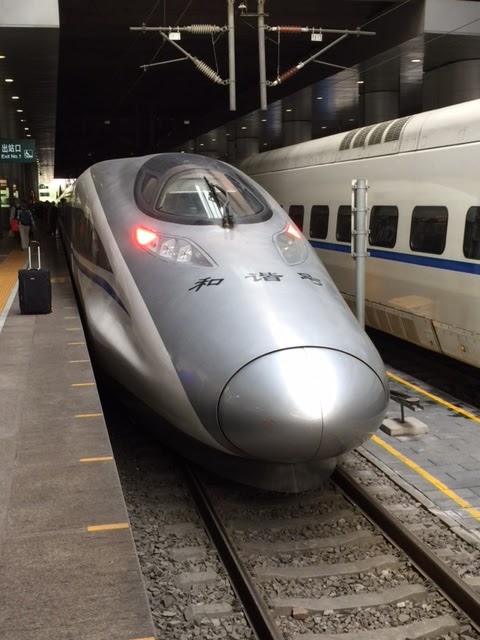
our high speed train from Beijing to Xi'an
We’re flying, at nearly 200 miles per hour, through the brilliant green rice paddies of Central China, headed from Beijing to Xi’an on one of China’s many high speed trains.  The plain is pancake flat; the sky a rosy gray, a mix of clouds and the remains of the sandstorm that blew through here yesterday.
The train is clean, if slightly shabby.  A lady with a mop wipes the floors in between stops.  Our first-class seats are wide recliners, so we’re happily able to nap.  The toilets are the squat variety, which I’m not very fond of, but many Chinese prefer, thinking they are cleaner than the sit-down kind.  We ordered hot box lunches which were edible if not gourmet.  All in all, a nice change from the 6 flights we’ll be taking on the rest of our travels in China.
There are a few people working in their fields, but no tractors visible from the train.  Most of the farms are tiny and don’t lend themselves well to mechanization.  China is trying to move farmers to the cities and consolidate agricultural land so it can be worked more efficiently.  This, like so much over the last 30 years, is a massive change in an ancient way of life, moving at a speed too rapid for many people to absorb.  There are thousands of protests, but, in the end, people don’t have a choice.
fields and mountains between Beijing and Xi'an

We keep crisscrossing highways, another example of China’s enormous investment in infrastructure.  As we glide (and this is, indeed, a smooth ride) into the many cities along our way, there are the same skyscraper apartment blocks, seemingly hundreds of yellowish or gray or brown buildings all alike, jutting upward in narrow spikes that look like they’ll bend in a high wind.  I wonder how anyone finds her apartment in the countless tall buildings filling each complex.
Everywhere there are cranes.  China continues its building boom, with housing prices high and credit, provided by government-owned banks, easy to get.  Despite constant speculation about a burst in China’s housing bubble, it hasn’t happened yet, though it’s hard to see why not.  There are thousands of apartment blocks under construction on the outskirts of every city.  And there are hundreds of cities we’ve never heard of, where tourists don’t go, whose populations surpass 5 million. 
Every one  of them seems to be building, building.  Yet many buildings, both apartment and office, are empty.
2 apartment blocks, all alike

 Having denuded its mountains and plains of trees over too many years, China has been on a tree-planting crusade for the last 20 years.  They’ve planted rows of trees along every street and highway and throughout their housing and office complexes.  Even in rural areas, farmers are planting trees to fill empty spaces and block the ceaseless winds.  It’s an important start on improving its environment, but China has so far to go before its air and water are clean. 
At every train station, passengers are reminded “to please get off in an orderly fashion”.  That’s not the usual way in teeming China.  At the Beijing train station this morning, people jumped over barriers and slithered through the long queues aiming for a more strategic position  as we all moved slowly towards each of the several layers of security.  You have to broaden your physical profile in order to hold your place in line.
I remember our early visits to China when we’d see thousands of people waiting outside train stations for days to buy tickets home for Chinese New Year.  That was when there were no highways and few trains.  People might travel for days to and from their jobs in places like the Pearl River Delta, Suzhou, Tianjin and Guangzhou on the few trains that operated then.  Now, there are dozens of choices and, though the stations and trains are crowded, people can get where they want to go easily.  China has done an unimaginable job of transforming its infrastructure in less than 30 years.  And the Chinese people are taking advantage of it with their new cars and new ability to travel to all corners of their country.  It is an astonishing transformation.


Friday, May 19, 2017

Xi'an's terracotta warriors and more

rows of terracotta warriors in pit 1
Most people traveling to China visit the ancient capital of Xi'an, the starting point of the Silk Road. This was where camel and horse caravans laden with silks and jade and other goods began their journey to the great cities of the Middle East and even Europe.  The caravans themselves did not travel the entire Silk Road, but met other traders in cities along the way, such as Dunhuang and Kashgar in the Gobi Desert, where they exchanged goods and sent their wares on their way farther west, returning with the items in high demand in Chinese markets.
horse and soldiers awaiting reconstruction
a warrior's face
The first emperor of China, Qin Shi Huang, started his tomb and filled it with magnificent terracota warriors to protect him in the afterlife.  Artisans worked for 37 years to complete the warriors, horses and chariots that filled his tomb.  So far 8000 have been discovered, all smashed into countless pieces and carefully reconstructed by archaeologists and modern-day artisans.  The warriors all had different faces, which makes them seem like they are living their difficult lives even today.
The first time I visited Xi'an, in 1987, there was only 1 pit that had been excavated, covered by a tin roof, with a graveled parking lot abutting the site.  Today, there are 3 pits, carefully protected in large buildings where archaeologists work daily to reconstruct all the soldiers they are finding.
terracotta horses that used to be hitched to a cart
The warriors were discovered in 1974 when a farmer was digging a well and turned up pieces of a soldier's head with his shovel.  The amount of work that has been done since then is astonishing, like so much in China.  Sometimes, that farmer sits in the gift shop signing books, a much easier way to make a living that the hard work of farming that he did for so long.
top of Xi'an's wall
Xi'an is still a walled city, though the city itself has far outgrown its original boundary to become a manufacturing center with 9 million people.  The wall is high and wide, 14 kilometers around, and perfect for a long walk or short bike ride.  You can ride a truly awful bike around the Wall in an hour, but be prepared for a seat that collapses on you or pedals that stick to your shoes and handlebars that aim only for the many holes that pock the surface of the Wall.  Nevertheless, it is one of the really fun things to do in Xi'an and lets you peer down into the backyards of lives of the citizenry.
golden Buddha in the Pagoda
The Wild Goose Pagoda is another enjoyable visit.  Again, 30 years ago during my first visit, it was decrepit with weeds surrounding it and a sagging fence.  Today, it has been restored and is the center of a lively tourist market, filled with shops selling junky souvenirs.  There is an art school and gallery that is part of the pagoda complex.  Local artists sell their art to support the pagoda, which has returned to being a Buddhist religious site, including about 50 monks who maintain the premises and offer tours.  From the top of the Pagoda, you can look out across this large city, though smog obstructs the view.
Wild Goose Pagoda
Muslim Street food stall
At night, it's fun to enjoy a dumpling dinner, a specialty of Xi'an, and walk around the wall or through the busy city streets.  Muslim Street is right by the bell tower and is packed with people enjoying the food stalls every night.
temple just inside the wall


Rainy day in Lijiang--and still beautiful

Jade Dragon Snow Mountain on a sunny day--photo taken on our 2010 trip
lower peaks of Jade Dragon Snow Mountain in the mist and rain

Yesterday we left Chengdu for Lijiang about noon, flying high up to the Tibetan Plateau.  The flight was very bumpy and, just as we were making our final approach to the Lijiang Airport, set in a deep mountain valley, we pulled up as the pilot announced we were going back to Chengdu.  A thunderstorm had developed right over the Lijiang airport and no planes were able to land.
homes in Lijiang's Old City
Back to Chengdu we went, where we waited 4 hours in the terminal for a new take-off and landing slot.  Brian Kwok, our friend and travel agent, is a techie who has an app on his phone that lets him see where flights are in the air anywhere in the world.  There were hundreds of planes flying the Chengdu/Lijiang/Kunming airspace, so no surprise that we were long delayed.
We finally landed in this beautiful place in time to dump our bags in the stunning Intercontinental Hotel whose back gate leads right into Lijiang's compact and charming Old City and head for a very local restaurant for typical Naxi food, beer and barely drinkable Great Wall wine.
food stalls in Lijiang's main square at night
There are 22 minority groups in Lijiang, with the Naxi making up 30% of the minority population. They are mountain people, farmers and herders, whose traditional crafts used to support them during lean times.  The emperors and warlords bought their embroidery, metalware and woodworking.  But, the Cultural Revolution destroyed that because it was "capitalist", so the mountain tribes were plunged back into poverty.
stone courtyard in traditional Naxi house
During Xiang Jemin's presidency of China, he began to rebuild the crafts, helping the Naxi and other minority groups open schools for teaching their traditional crafts.  Today, the teachers also go to the more remote villages to teach the crafts to women so they can supplement their families' farming incomes.  The work is creative and beautiful.
We spent most of the day on Jade Dragon Snow Mountain, the 18,500 foot peak that looms over Lijiang.  Given the rain, often heavy, we could only see the lower reaches of the mountain, so we're hoping that tomorrow will bring a glimpse of this stunning peak.  Don and I have been here 3 times before, so have beautiful photos of the mountain on sunny days (which I'll add to this blog once I get home).  Nonetheless, we walked on boardwalks through the woods and around a pretty meadow with yaks grazing and 3 dejected horses, including one very young colt, turning their backs to the chilling rain.
dejected horses in the rain
Then to the Naxi village for lunch at another very local restaurant with windows open and no heat. But a couple of cups of hot tea and some delicious Naxi food warmed us anyway.
pictograph of pregnant woman
The village is a center for teaching crafts, and therefore for tourists, so has many shops and restored homes, cobbled streets and some level of prosperity.
The Naxi writing is pictographs, some that clearly tell you what they mean.  Most young people haven't learned the written language, though they speak the language as a matter of course, so some of the elders are teaching pictographs to them. 
Mufu Mansion buildings

As with so many cultures that have been suppressed, Naxi culture is enjoying a comeback.
Lijiang itself has a wonderful Old City, built about 700 years ago of wood, close-packed traditional homes and shops.  The cobbled alleyways are closed to vehicles, fortunately, since tourists clog the streets when the weather is reasonable.  The Mufu Mansion is one of the tourist highlights, but just wandering through the narrow streets is the best thing to do in Lijiang.


Saturday, May 13, 2017

Traveling in China once again

ceremonial hall--Forbidden City
A year ago, my brother and sister-in-law told me they’d like us to plan a trip to China for them and some friends.  So, now, here we are once again, my brother and sister-in-law, sister and brother-in-law and 5 additional friends, in this remarkable country.  Don and I first visited exactly 30 years ago (see an upcoming blog about how we've watched China’s transformation into the world’s second largest economy) and have returned 20 times since then.  We continue to marvel at what China has done over that time.
Great Wall meandering across the mountains near Beijing

Beijing is a must-see city.  Though its broad avenues are a driver’s nightmare now that the city has 7 million cars, seemingly on the streets all at once, and generally terrible air quality, it is center of Chinese history and culture.  The Great Wall is an hour away—and a thrill to see no matter how many times I’ve visited.  The Summer Palace is a monument to imperial decadence and a favorite destination for Chinese (and all) tourists.  There are museums, art districts, excellent restaurants, a few superb temples that survived the Cultural Revolution, supermalls, the infamous and enormous Tiananmen Square and the magnificent and huge Forbidden City.  And much more.
panorama of Forbidden City courtyard under surprisingly blue skies

We got lucky this trip.  A sandstorm blew through Beijing the day before we arrived, but the winds also cleared the air of the oppressive smog that usually covers the city.  I’ve never seen blue sky in Beijing before, but we enjoyed 2 days of clear air.  My past photos of the Great Wall are murky, but this time, we could see sections of the Wall that had been hidden by the smog on previous visits.  We climbed as high up the steep wall as we could go breathing easily.  One tip here, visit the Wall in the afternoon when the swarms of tourists are smaller.  By the time we left about 5 p.m., there were only a few people on the Wall, whereas in the morning, crowds make it difficult to move on the lower sections of the Wall.
children playing at the Summer Palace

This part of the Great Wall has all been rebuilt, but that doesn’t detract from its power.  It is a marvel of human effort and folly, built at the expense of a million lives and destined to fail at its objective of keeping China safe from Mongol conquerors.  Near Beijing, the Wall meanders over very steep limestone mountains.  In its earlier form, it was built of earth with mud-brick watch towers.  Today, it is made of limestone filled in with concrete.  Its steep, irregular steps are an effort to climb and fortunately deter most of the tourists from its higher reaches, giving us freedom of movement above the first watch tower.  Nonetheless, there were women in spiked heels clambering up even the ladder-steep sections, breathless and excited.  In a few days, we will fly to Jiayuguan where the wall began, far out in the Gobi Desert.
temple and lake at the Summer Palace

Tiananmen Square and the Forbidden City, home of the emperors, are at the heart of the city.  In the last 30 years, Beijing has grown to 23 million people, so the city has moved far out from its center.  Every couple of miles, there is a ring road circling the city, connected to the other ring roads by wide boulevards literally overflowing with cars.  They are about to begin construction of the 7th ring road and still the city has built way beyond even this farthest point. 

outer wall and moat of the Forbidden City
Beijing is about to host the heads of state of the Silk Road countries.  China has a major push underway to expand its influence throughout Central Asia via its “Silk Road Initiative”, ostensibly to encourage tourism along this fabled trade route, but also to create a sense of common history and destiny.  So, security was beginning to be even tighter than usual as the city prepared for its high level guests.
Now you need passports to get into the most popular attractions, matched to your entry tickets so scalpers can't buy low and sell high.  Security is always tight around Tiananmen Square where foreigners can pass through easily, but Chinese must wait in long lines to get through security and into the square.  On one side is the enormous Great Hall of the People, where President Richard Nixon was hosted at a huge state banquet when he visited China in 1972.
Great Hall of the People
Most Chinese live in tiny apartments or single rooms, chilly in the winter and stuffy in the hot summers.  
women singing at the Temple of Heaven
Retirees (who often must retire before reaching 60) spend much of their days in the parks and temples with friends, exercising, playing cards and talking.  The Temple of Heaven is a haven for Chinese who fill their days there with a variety of social activities.  Now, the government has installed exercise equipment to add to the tai chi many Chinese practice every morning.
Round temple at the huge Temple of Heaven

The adorable pandas of Chengdu

8 month old panda baby 
Chengdu, China's Panda Breeding Center is pure joy.  We're here leading a group of 11 of us on a very busy trip to China, so I'm going to be blogging out of sequence, starting with the adorable Giant Panda babies we visited today.
There are about 2400 Giant Pandas alive in the world today, about half of them in captivity in zoos, breeding centers and panda reserves where these charming animals are protected.  The Giant Panda was on the road to extinction before China started capturing injured and starving animals in the wild and putting them in what amounts to protective custody.
a wistful little guy
Pandas are solitary creatures, setting up territories in bamboo forests.  Several factors have led to their near-demise.  Female pandas ovulate only once a year.  If the female is not near a male, she does not breed that year, losing a precious opportunity to reproduce.
Newborn babies are tiny rat-like creatures, 1/1000th the size of their mothers.  A first-time mother may not know what to do with her baby, which has almost no hair, unformed ears and closed eyes, a totally helpless, but squirmy and screechy infant.  So, the baby may die from neglect or injury.
The bamboo forests of China are nearly gone, so many Giant Pandas have starved to death.  They can only absorb about 30% of the food value of the bamboo, so have to eat large quantities of a vanishing resource to survive.  While they also eat meat, they are slow-moving animals who can rarely catch prey.  China has set aside reserves of bamboo forest and is trying, slowly, to move some of the pandas it is breeding into the wild.  Last year, they released a male and female after several years of living in semi-wild conditions.  Only the female survived.  The male was done in by a would-be mate who apparently did not appreciate his advances.
babies are playful
Last year, 24 babies were born at the Chengdu breeding center, with an amazing 23 surviving. The babies are taken from their mothers at birth to protect them and put in incubators. They are put with their mothers 2 to 3 hours daily to nurse.  In between, the handlers milk the mothers by feeding them honey-dipped bamboo sticks through the bars of their enclosures while a second handler actually milks the mother, who happily cares only about the honey and bamboo.
mother panda enjoying her bamboo
Chengdu is hot and humid in the summer and cold and frosty in the winter.  The pandas prefer the winter in their fluffy black and white coats.  In the summer, they could die from the heat, so their handlers move them inside to stay cool during the middle part of the day.
We watched as handlers coaxed the 6 to 8 month old babies into their arms to cart them to their large inside enclosures.  When the babies saw them coming, they raced up the trees to avoid being taken inside.  With a lot of wheedling, they eventually clambered down from the trees and allowed their handlers to cuddle them in their arms.
This breeding center also raises red pandas, related to raccoons.  They have enclosures, but frequently run along the walkways greeting the thousands of visitors.
red panda


baby escaping from handler
deciding it's time to come down
on its way

giving in to its handler