Friday, March 3, 2017

Santiago de Cuba, where Castro's revolution began

Fidel Castro announced the success of the revolution from the main balcony of this city hall in Santiago de Cuba
We talked to people who looked at Cuba and Cuban/U.S. relations from an American point of view as well as with Cubans who gave us their perspective (my last blog).  I have summarized these conversations below.
There are 4 transitions underway in Cuba:
1.  The political transition that will happen when Raul Castro steps down on Feb. 24, 2018.  While he is stepping down as president, he is also head of the Communist Party, the military and the Council of Ministers.  He hasn't said what he'll do about these other jobs.  So, Cuba is experiencing its own political turmoil as various candidates juggle for position to succeed Raul Castro.
1.    
  
symbol of the outgoing generation of leaders

child in shop door--Cuba's future leader


22.     The economic transition—the government wants a human-based social system in which the government provides health care, education and basic food supplies.  But, it’s hard to maintain full social programs when you have an aging population.  Twenty percent of Cuba’s population is over 60, so the private sector is becoming ever more essential to help provide for them.  While there are over 200 economic areas that are open to private business (taxis, restaurants, bed and breakfasts), they do not play a big role in the economy.
3.     
new economy--selling plantains on street
 
The generational transition--from the aged Castros to a younger group of potential leaders, resulting from Fidel Castro’s death and the looming handover of power from Raul Castro to a new, and younger, president.  The younger generation of Cubans wants new economic opportunities.  They are less committed to the revolution and more interested in providing for the well-being of their families and themselves.
bodega (ration store) with little on shelves--old economy


          4. Then, of course, there is the technical transition where even Cuba is slowly moving into the internet age.  While it is still very difficult to connect to the internet—slow, very limited connectivity—there are now 300 areas in the country, including parks and plazas, where people can get access to the internet.  And they are full of people on their smart phones, on the internet.  Prices for internet access are still high for the average Cuban, but are coming down.
primary school classroom--triumph of the revolution
Cuba’s dilemma is how to maintain the gains of the revolution while moving into the future it’s younger citizens demand.
Since Pres. Obama opened the door to more diplomacy and exchange opportunities, the number of people-to-people delegations has grown dramatically, with an increase in American tourism of 84% from 2015 to the end of 2016.  Last year, 600,000 Americans visited Cuba.  This is a huge benefit for the Cuban economy and has generated thousands of private businesses, ranging from bed and breakfast lodging to guiding to private transportation and restaurants.
woman scavenging--still a long way to go

The U.S. and many Cuban Americans want to support the private sector in Cuba.  Ultimately, Cuba needs  a stronger currency and greater transparency if it wants to attract foreign investors.  In communications, direct mail service was implemented in 2014.  Before, mail had to be routed through some other country, such as Mexico or Panama, often taking 6 months to reach the U.S.  Even the cargo carriers are exploring their opportunities in Cuba.  And 4 major U.S. phone carriers now have roaming agreements in place with Cubatel, making calls from Cuba to the U.S. on our mobile phones quite a bit cheaper than even a year ago.
Since the partial opening in late 2014, the U.S. and Cuba have signed 22 memorandums of understanding, each of which had to be carefully negotiated by the 2 parties, and has sent over 50 high level government officials, including, of course, Pres. Obama to Cuba.  More American businesspeople are coming to Cuba and more Cubans, to the U.S.
woodblock print by artist with 10 year U.S.visa
Remittances total about $3.4 billion a year from the U.S. to Cuba and are the third biggest source of foreign exchange.  The government is worried about the growing discrepancy between rich and poor, particularly since this gap tends to divide the country by race and geography.  They can’t tax remittances, but they do tax the importation of goods and the profits of private businesses.  The private sector is pretty cautious and tends to stay on the right side of the law, keeping good records of their profits.
The president can’t just eliminate the U.S. embargo; only Congress can lift the sanctions.  Pres. Obama’s executive orders regarding Cuba resulted in a lot more activity between the 2 countries, such as the agreement that permitted scheduled flights from a number of U.S. cities to several Cuban cities, a huge improvement over the charter flights that used to service Cuba.
Big global companies are looking into Cuba—and Cuba favors the larger companies.  The government doesn’t really want start-ups or smaller companies without the resources, staying power and patience of the multinationals.  The medium and smaller companies are having a hard time getting opportunities in Cuba.  Most decisions go to the top of the government and tend to sit there. For the smaller companies, getting meetings with officials is very difficult.  They can’t set up relationships easily, often have trouble getting a visa and get slow or no responses to their inquiries.  So many of them just give up.
outside art market on the street

American multinationals and other potential investors have been telling the government that interest in Cuba won’t last if it continues to be so difficult to do business there.  But, the government doesn’t believe it.  Now their opportunities for foreign investment are smaller than before.  The major industries that are opening to foreign investment are airlines, telecommunications, cargo carriers, manufacturing, agriculture and the hospitality industry.
clinic examination room, Playa Giron
Cubans now have the same requirements as the rest of the world to get U.S. visas.  To get a non-immigrant visa, you must be able to prove you will not stay in the U.S.  The assumption is that everyone wants to stay in the U.S.  However, it is much easier for some Cubans to get visas than others.  Artists we met told us they have 5 or 10 year visas with multiple entries allowed.  The U.S. has made big efforts to encourage free expression through art, music and writing in Cuba.
Cubans can praise but not protest government policies.  The government reports that there are 70 to 100 people in prison for expressing political views.  If you talk to Cubans about human rights, the Cubans say that socio-economic rights (access to health care, housing, education and food) are human rights.  They point out that police are killing black men in our cities, so who are we to talk to them about human rights.
children watching clown--Museo de Bellas Artes

Cuba has a very old population for a developing country, with 20% of people being over 60.  They have the demographics of Switzerland but the economy of Haiti.  To deal with the problem of providing social services to their aging population, the government has raised taxes.  On incomes of more than $25 per month, they levy a $2 tax.  They are bringing back the income tax which hasn’t been in place since before the revolution.  Because they export so many doctors and other medical personnel (their largest export), it has become harder to access health care.  There are now 60,000 doctors working overseas.
Exceptions to the U.S. embargo include medicine and agricultural products (Cuba imports $500 million in food every year from the U.S.).  The Cubans would prefer to manufacture their drugs here.  There is real scarcity in pharmacies.
mosaic boat with revolutionaries--Jose Fuster neighborhood
The American side of the “small tractor company” story varies a bit from the Cuban side (see my blog on Cubans’ views of the U.S.).  This company planned to manufacture a very small tractor in Cuba priced to meet Cuban budgets and sized for Cuban fields.  The company thought it would be able to open a factory in a planned duty free zone by the Havana port.  But, the Cubans finally turned it down, saying the tractor was too small to be of much use, had no advanced technology, and didn’t generate enough jobs.  Of the 400 companies that have applied for licenses in the duty free zone, only 18 have been approved.
unemployed man outside bodega

People who start private businesses like paladars and bed and breakfasts buy their goods for these businesses mostly in the U.S.  There is a “Samsonite express” between the U.S. and Cuba, with Cubans making their livings by going to the U.S. with 10 to 12 suitcases, loading them with U.S. goods, then returning to Cuba with their haul for their clients.  The remittances from the U.S. to Cuba go right back to the U.S. to buy these goods and don’t do much for creating jobs in Cuba outside those small businesses.  The customs agents will often let 7 or 8 large suitcases to get in duty-free and then dig through the 8th or 9th or 10th bag and charge duties on the goods they contain.
A bus boy in a tourist restaurant makes much more money than a doctor or engineer, so there has been a big move to the tourist industry.  This is a problem for the government which pays for the education of its professionals, only to lose them to lesser jobs that pay so much better.
living room of farmer's home with photo of Che Guevara
The Communist Party will determine the next president.  There are several front runners, with the current Vice President at the top of the list for the moment.  He is a party man who believes in the existing mission of the party.  The Foreign Minister is another possibility, also a party man.  And then, there’s Alejandro Castro, son of Raul Castro, who might be in the running.  This will be tricky for the party since the Castros have insisted they will not allow a dynasty to be established in Cuba.  Soon we’ll start seeing a bigger public face of the expected top candidate.

Young people don’t have a lot of interest in politics.  They’re much more concerned about starting families and earning enough money to support them.  They have always thought they could just leave if things didn’t go well.  But now, with the lifting of the “wet foot, dry foot” rule that allowed any Cuban who set one foot on American soil (even if the other foot was in the water off the sandy beach), they will have less opportunity to go to the U.S. and may become more interested in Cuba’s policies.
paladar (private restaurant) in Vinales Valley

The U.S. and Cuba from a Cuban perspective

rural health clinic near Playa Giron--a big achievement of the revolution
A number of Cubans gave us their point of view about relations between the U.S. and Cuba and about Cuba's politics, foreign policy and economy.  Their views are summarized below.
During the heyday of the Soviet Union, Cuba relied heavily on the USSR for financial aid and a market for its products, particularly sugar.  The U.S. embargo cut Cuba off from many world markets.
When the Soviet Union fell, Cuba lost 80% of its overseas market and foreign exchange virtually overnight.  This was the beginning of the “special period”, a time of great suffering for Cubans, including actual starvation.  The government decided in 1991 to implement its first foreign investment law in hopes of attracting foreign capital, which it saw as a complement to a government-run economy. 
swamp children before the revolution

The government also decided to decentralize the central economic planning system, devolving more authority to the provinces and municipalities.  Eventually, about 7 or 8 years ago, they opened a tiny window for the private sector, allowing small family businesses in tourism and transportation.  Today, 500,000 Cubans are employed in the private sector and there is no going back.
Now most industries, not including the military, energy, health and education, are open to foreign investment, though the government always retains a percentage of the ownership (generally a controlling interest).  In tourism, government ownership is at least 51%.  If there is a really strong, comprehensive project, they might consider taking a smaller interest.
Cuba, Mexico and the U.S. negotiated an agreement dividing the Gulf of Mexico into 3 areas of exploration for oil and gas.  Cuba now produces about half the oil it needs.  Cuba is trying to improve its production with newer technology, particularly since most of its oil is heavy, high sulfur crude.  The country has 5 refineries.  A Russian-designed refinery built in the 1980’s never worked until Venezuela stepped in to get it functioning.  Now, Cuba is trying to invest more in renewable energy, particularly wind and solar.
young woman soldier fighting at Bay of Pigs

On an earlier trip, we had been told about a U.S. tractor factory that made small tractors, priced for the Cuban market, that thought it was close to getting government approval.  Ultimately, it was rejected because its tractors were small and underpowered for Cuban soils and needs. Cubans were a bit offended by this, feeling that they were getting an inferior product.
Pres. Obama granted 4 ferry licenses to U.S. companies to conduct operations between Florida and Cuba, but the Cuban government didn’t reciprocate with its own approval.  Cuba simply doesn’t have the facilities to handle so much ferry traffic, including:  no ferry terminal in Havana, security concerns, no cargo allowed as long as the embargo is in effect (and ferries carry cargo as well as people), inadequate customs personnel and facilities.
Compensation for nationalized American properties continues to be a testy subject.  The Helms-Burton law gave Cuban-Americans who were Cuban citizens at the time of the revolution and are now U.S. citizens the right to compensation for property confiscated by the Cuban government.  But these people are now U.S. citizens and don’t have a right to demand compensation from the Cuban government.  Cuba settled its claims with European countries, but the U.S. refused to negotiate the same kind of compensation.  (Interestingly, when we talked to the Swiss ambassador at his home, he said exactly the same thing.)
Cuba knows it needs to negotiate a resolution to all these U.S. claims and tried to do so in the 1960’s.  The U.S. gave Cuba tax credits for its claims against the U.S., but that is not the same as actual compensation.
private food stall on street of Cienfuegos

Right after the revolution, other countries offered oil to Cuba, but the American refineries in Cuba refused to refine it on orders from the U.S. government.  So Cuba nationalized the refineries.  The reality is that both sides have claims and must negotiate to resolve them.
In regards to human rights, Cuba has a single political party and no free press.  It doesn’t have free elections.  Cuba’s political system is different from that of the U.S.  The U.S. has close relations with many countries that have no political parties at all, that are living in the Middle Ages.  In negotiations, the U.S. keeps moving the goalpost (see Backdoor to Cuba for verification of that).  Friends of Cuba say it’s a paradise; enemies say it’s hell.  It’s neither.
The U.S. human rights record is not always so good.  Human rights are more than just a political system.  Problems didn’t begin with Castro.  They began during the Spanish colonization of Cuba and continued with the U.S. colonization and intolerance of Cuba’s independence.  Cuba has paid a high price for its independence.  Politics in Cuba are conditioned by its relationship with the U.S.  Cuba is portrayed as a threat to the U.S. because it encouraged revolutions in Latin America and fought in African wars. 
private transportation--goat cart in Bayamo

Cubans think U.S. policies are a threat to Cuba.  The core of the problem is Cuba’s independence.  Cubans don’t have any animosity towards the American people.  Fidel always talked about the differences between the American government and the American people.  The Cold War dictated U.S. foreign policy for decades.  During the Reagan era, Cuba was very afraid of the U.S.
Fidel Castro was very analytical, well-informed and loquacious.  He received several huge briefing books every morning.  He slept only a few hours and would meet with people most of the night.  He exercised, didn’t eat or drink too much, gave up smoking in the 1970’s to set an example for Cubans.                             Reagan blamed Cuba for the revolutions it supported in Latin America which were not created by the Cubans, but for which the Cubans had great sympathy. By back channels, the U.S. let Cuba know it would go to the source of the problem--Cuba.  This led Cuba to build defenses and become more active diplomatically.  Cuba became a leader among non-aligned nations and at the U.N.  Cuba was always willing to negotiate.  

sugar cane worker near Trinidad
Cuba is trying to move from an extremely centralized economy to a more open one.  The government has set goals, but does not know how to reach them.  Raul Castro sped up the process of opening to foreign investment.
Cuba tried to build utopia and achieved a lot.  But it couldn’t create an economy that could sustain that utopia.  Now, Cuba has to face the reality of what it can afford to do.  They must develop the economy, with the private sector being one important part.  They’re trying to save the best of their achievements, free health care and education.  In the process of creating utopia, they also created a very paternalistic society.  They don’t have the resources to maintain this.  Cuba must have a middle class in the future.
horses and buggies are very common in Cuba


Politically, Raul Castro will give up the presidency of the country in February, 2018, but he will continue as Secretary of the Communist Party until 2020. So, he will remain a powerful figure.

free market vegetable stand--too expensive for most Cubans
The cornerstone of Cuba’s future must be its independence.  It must maintain its free access to health care, education and social security.  Everyone pays for these rights.  Health and education give everyone the opportunity to succeed.  Cuba now needs to give individuals more opportunities to succeed, but the rights of society need to prevail over the rights of the individual.  Entrepreneurs don’t need to be divorced from Cuba’s utopia, but, instead, be a part of it.

Wednesday, March 1, 2017

Some of Cuba's most successful artists

Lisandra Ramirez' "Cats"
One day, we were fortunate enough to visit several of Cuba's top artists in their studios with a Cuban art expert.  These are artists who sell their works in U.S. galleries and have works displayed in museum galleries around the world.  They are quite remarkable.  They also have easy access to the United States as they can get 5 and 10 year visas to visit, show their work and, in many cases, cast their sculptures here.
calling the U.S. from Cuba, nickel, The-Merger
The expert also took us to the Museo de Bellas Artes, a beautiful museum in Havana with a comprehensive collection of Cuban and world art.  The expert told us that Castro's revolution put a tight lid on dissent in any form.  Cubans say that "inside the revolution, everything is possible; outside the revolution, nothing is possible."  In other words, if you were an artist or writer or musician who portrayed the revolution in a positive light, you could show your work in public and be rewarded by the regime.  If you were a dissenter, you had to hide your works or face sanctions and even imprisonment.
sugar cane workers, Museo de Bellas Artes
calling Cuba from the U.S., nickel, The-Merger
Artists whose works were critical of the revolution hid their works or sold them, if they could, to private collectors who surreptitiously hung them on their walls.  You can see all this art today in the Museum.  It is much like viewing Soviet art which depicted the glorious and magnificent workers toiling in factories and fields in support of the Communist revolution.  And, then, there were the Soviet impressionists, among others, whose gorgeous works were hidden in barns and basements to keep them from the Soviet authorities.
The "gray years" of Cuban art were from 1971 to 1976, when repression was severe.  Creative life opened up in the 1980's, Cubans golden years when the Soviet Union supported the Cuban economy and artists had time to create a new reality.  The government even admitted to mistakes and committed to rectifying those mistakes.  Art gained more of a social conscience.
Ibrahim Miranda's linear works on maps
But, in 1989, when the Soviet Union fell, the Cuban economy went into total collapse, so disastrously that many people were starving.  Artists started emigrating to Mexico and other countries where they could sell their work.  This was a severe creativity drain, but it did help to make the world aware of the energy and beauty of Cuban art.
Today, there is more freedom than during the early years of the revolution.  We visited one artist, Ibrahim Miranda, (www.ibrahimmiranda.com) who uses old maps as the background for his printmaking.  They are fascinating works that sell well in Cuba and abroad.  He is one of the artists who travels freely to the United States.  His work is included in the Museo de Bellas Artes in Havana, and also in the Museum of Modern Art in New York and the National Gallery of Art in Washington in addition to many more museums around the world.
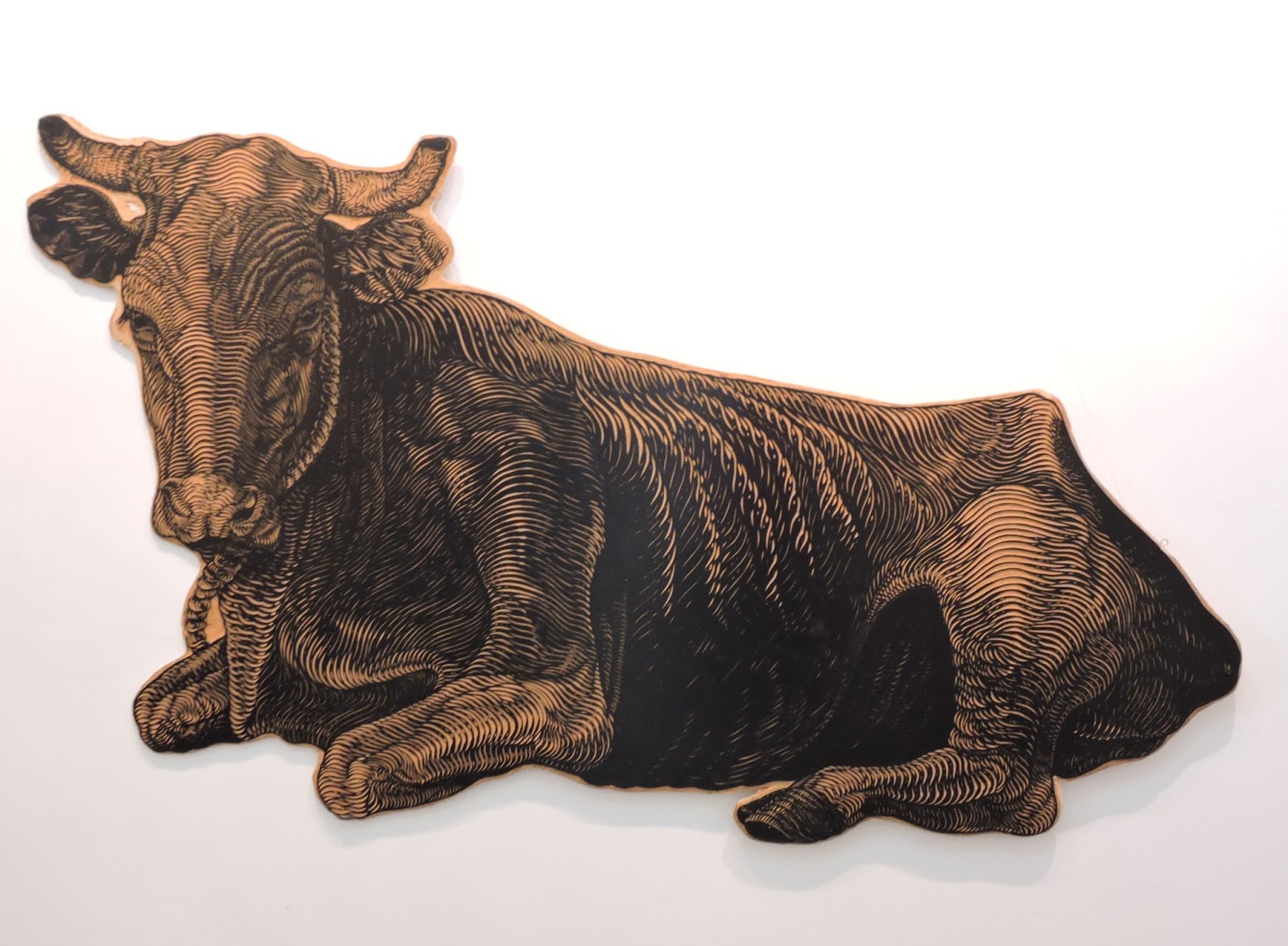
Ibrahim Miranda's cow
The-merger (www.themergerart.com) is a group of 3 artists who work together on all their art and sculpture.  Some of their pieces sell for $20,000, so they've obviously hit the big time.  They cast all their sculptures--mostly stainless steel and bronze--in the United States.  Cuba doesn't have the capability to cast large, complicated pieces.
the dancer, The-Merger
Lisandra Ramirez also sells her work, as does her boyfriend, Osmeivy Ortega, in the United States. Many of her sculptures are whimsical, as her cats who are doing what she says (and we cat owners know) cats do, look with bemusement and superiority at their human world.  You can see their works at this website:  www.pupilarteestudio.com/.
tree of life deer, Lisandra Ramirez


Monday, February 27, 2017

Making life work in Cuba

Cuban house in need of repair, but still a residence
The complexity of life in Cuba became bizarrely apparent one night when we had dinner with 2 Cubans who explained some of the rules concerning inheriting or transferring property.  I’ll try to make this somewhat intelligible, so bear with me.
One person Don and I had met on our first visit to Cuba had told us how he and his wife were slowly building their house.  It turned out to be a much more complicated endeavor than he’d discussed with us on our first trip to the country.
typical Cuban transportation, particularly outside of Havana
First, in Cuba, you can only give your house or car or personal property to a child or spouse.  You can’t sell it to another person, though you can swap property between two parties (more on that in a minute).  If a married couple divorces, you can transfer property between divorcing partners in order to equalize a divorce settlement.
Our acquaintance, whom I’ll call Arian (not his real name), and his wife have known each other since primary school.  They began dating in high school and continued to see each other even after he went off to the university, which she was unable to attend because her grades in high school were too low.  They’ve now been together 10 years and have 2 children and a tiny house.  But, she’s not officially his wife.  This wouldn’t be all that strange except for the circumstances that have kept them from marrying.
colorful, restored homes in Trinidad
Arian wanted to find a piece of land where he could build a house.  You can acquire the land if your parents or spouse have some land they can give you.  He found a piece of land, but it was owned by an older woman who couldn’t give or sell it to him.  So, he married her in a 4 minute ceremony at the municipal office (this after considerable discussion with his girlfriend, who agreed that this was necessary).  He then paid his official wife, whom he never has and never will live with, for her land which, because they were married, she was legally able to transfer to him. 
Normally, and not uncommonly in Cuba, he would have divorced her since he now owned the land he wanted, but because of even more quirks in Cuba’s laws, he had to put in a foundation and 27 square meter room in order to keep the land.  He didn’t have the money to do this, so he had to stay married until he could save the money to build the required structure.
Initially, he and his girlfriend built a 15 square meter room with a bathroom.  This wasn't large enough to meet the government requirements for maintaining ownership of the land.  Even though they started the house 7 years ago, saving the money for expensive materials with 2 children is very difficult.  Until they can find a larger house for their swap, the four of the them all sleep together in 1 tiny room and live in another.  His desire is to have a balcony or terrace or small garden where his children can play outside.
crumbling apartment building, Havana
Originally, Arian and his wife hoped to build a second floor with 2 bedrooms and turn their tiny 2 room downstairs into a kitchen/living space.  Now, they are thinking about trying to swap their current home for a larger one.  That would require paying extra money for the larger home, the difference between its value and the value of their home.  Meanwhile, he needs to stay married to the woman from whom he bought his land years ago in order to maintain ownership until he can swap the land and house.  Confusing?  Very much so, and pretty typical of the creative ways Cubans get the things they need.
Our other guest told us how he'd been able to build his house.  He found a woman with a single story house who needed a better roof.  He offered to build a concrete roof for her if she'd sell him the roof, again under the table, and let him build a second floor home on top of her house.  They reached a deal, not requiring that he marry her because she wasn't transferring land, just adding a story to her home, which he was paying for.
Cuba doesn't really have titles to homes, so his deal is a bit shaky, but he, too, is hoping to swap his apartment, which he built mostly himself, to someone else for a better and larger home.
private truck packed with travelers
Barter is key to the Cuban economy.  Few people could survive without doing deals under the table, buying and reselling items, renting or buying (usually with remittance money) an old car or truck to transport people who pay a couple of Cuban pesos for the ride, trading services with family and friends.
renovated apartment building, Havana
Life like this is very creative and very difficult. Everyone longs for the day the U.S. will lift its embargo, so futile since it has accomplished none of its goals--i.e., removing the Castros--in its 60 years of existence.  It has only served to impoverish the very Cubans we want to help.


Sunday, February 26, 2017

private travel in Cuba

sunset over lake near Holguin
Since I have blogged about Cuba on two previous trips, I will try to tell people’s stories this time around.  We were back in Cuba with a group, ten of us, taking virtually the same itinerary we took in October because we think it showcases the island very well.
cutting sugar cane with machetes in government field

This time, however, we flew American’s newly scheduled flight to Holguin, on the northeastern coast of Cuba, a vast improvement over the charter flights that were always late.  We did a “private” trip this time because the government refused to confirm any hotel reservations for us.  They told us they would guarantee a hotel in each city, but wouldn’t say which ones.  Since there are very few good hotels in Cuba, we were unwilling to leave it up to the government to tell us at the last minute where we’d be staying, which would most likely have been a barely acceptable or unacceptable hotel.
chef in one of the private restaurants (paladar)

So, we decided to take the private route, which means we stayed in private homes, used privately owned vans and the drivers who work for those owners and a private guide hired by our U.S. based travel agent who specializes in private tours.  There were 10 of us, so we had 2 vans.  You can’t get a bus if you travel privately because the government owns all the buses and won’t let you use them unless you are on a “government” tour.  The vans were 10 passenger and 6 passenger models with 2 delightful drivers, so we were very happy with them.
ration card used to by supplies in government store (bodega)

Something we learned after our first 3 nights in Cuba—private providers of accommodations also switch you to other private accommodations (hostals or casas) without telling you.  We had 5 rooms reserved in the best hostal in Santiago de Cuba and 1 in a lesser hostal, since we needed 6 rooms.  But, when we arrived at our reserved hostal, the owner told us she could only provide 3 rooms in her home and had booked 2 rooms in a second (turned out to be less desirable) hostal nearby and 1 room in a third hostal (considerably less desirable). 
Same thing happened to us in Camaguey, where we had a 7 room hostal for one night.  We were not told that we would be in a different hostal from the one we reserved until we arrived.  Our new accommodation was fine, but not as good as the first.  I was peeved, to say the least, particularly when our guide told me the same thing would be happening in Trinidad, where we’re staying 3 nights. 
band of musicians in plaza (private enterprise)

I called the Cuban concierge who was supposed to help us if we had problems on the trip, woke him up, I’m sure (it was Sunday morning), and told him I did not want this to happen again and to please fix the problem immediately.  Though he said he would, I also called our travel agent in Florida, who quickly got us returned to our booked accommodations.  So, if you travel privately in Cuba, be prepared to fight for what you paid for.  I think that these hostal owners share the government view that, provided your itinerary stays the same, you won’t care where you stay.  Wrong!  But, this kind of private business is quite new, so it may take some time to work out the kinks.  I think they overbook and then move the last arrivals to other accommodations.  So, until this becomes a more routine part of Cuban travel,  check and doublecheck and then call again to make sure you are getting what you expected.  One thing to understand about private accommodations in most of Cuba is that they are very basic--generally small rooms, 1 to 3 beds, a towel per person, no amenities except soap (not everywhere), clean, run by families (more about the families and their dreams in another blog).
private family-owned cars in Havana

One other note—we traveled legally to Cuba, so used a U.S. travel agency that is licensed by the U.S. Treasury Department to do business there.  They provided us with our visas and our letters of authorization that prove we are authorized to travel in Cuba.
The rest of our trip was smooth.  We had a gorgeous 7 room villa in Havana with a wonderful staff and lovely rooms.  The location was in Miramar, about 15 minutes from Old Havana, so not as convenient as staying in the center of the city if you want to sightsee on your own or shop—but, then, while the sightseeing is great, the shopping is minimal.  We all loved the villa despite the neighbor’s dog who barked long into the night (our villa owner has been informed and, hopefully, will deal with this significant annoyance).
our villa in Havana

More on the stories we heard in my next blogs.


Wednesday, February 22, 2017

a Cuban writer's story

outdoor bookstore in Old Havana
We just returned from our third trip to Cuba.  Since I've blogged about Cuba twice before, including our travels from Santiago de Cuba on the east end of the island to Havana and the Vinales Valley on the west, this time I will focus on people's lives and stories and the different views of U.S./Cuba relations held by Americans and Cubans.  Things are changing fast in Cuba in some ways and in others, there is no change.  Above all, Cubans, particularly government officials, value their independence from the U.S.  At the same time, every Cuban we talked to would love to come to the U.S., at least for a visit.
sunset over lake in SE Cuba
This is the first of several stories I'll tell over the next few days.
One person we met is a writer and poet.  He has been very active in negotiating with government officials to gain more artistic freedom for writers, artists, musicians and dancers.  Perhaps because Cubans have such a restricted life, they put enormous energy into their creative lives.
This writer, whom I’ll call Jose, but which isn’t his real name, is highly regarded in Cuba for his work on behalf of writers and artists.  His life is so circumscribed by poverty that he has turned to intellectual pursuits to give his life meaning amidst severe deprivation.  He seems to be very sad because of all his dreams that he knows he’ll never realize since they go beyond Cuba to a world he can’t afford to access.
ration book issued to every Cuban family to buy basic goods
He would love to travel outside Cuba, particularly to New York, but he’ll never be able to afford to apply for a U.S. visa ($160), much less buy a plane ticket even to Miami on the new and much cheaper scheduled flights between the U.S. and Cuba.  His dream is to experience New York’s cultural life, to walk the streets where artists show their work, visit the city’s great museums, wander through the bookstores, talk to fellow writers, even if only for a few days.  There is no chance he would overstay his visa because his wife needs his care and his grandson is his treasure.  But, besides the prohibitive cost of applying for a visa, his chances of actually getting one are near zero, especially now.
When I asked Jose what I could bring him and his family, he asked for vitamins because their diet is so poor.  I am guessing he makes about $10 to $12 per month, which he supplements with an occasional job translating books from English into Spanish.  Even in Cuba, this doesn’t buy much, meat on rare occasions, little in the way of fresh fruits and vegetables (which are in amazingly short supply in Cuba), mostly rice and beans which are subsidized by the government.
Bodega--ration store with very limited goods

Jose has published many articles, books of poetry, and anthologies.  He particularly enjoys the book fairs that attract hundreds of thousands of Cubans to Havana and other cities.  We were in Havana for part of their huge book fair this year, the only time Cubans can buy books from other countries.  The crowds were enormous, waiting for buses back into the city late into the evening.  This is one of the premier events in Cuba, not just for intellectuals, but for average citizens who want a chance to read about the world outside their island.
I’ve seen booksellers in Havana’s main plaza with their used books spread out on tables under the trees.  The government publishes some books every year, but because of the U.S. embargo, can’t get high quality paper on which to print the books, so they’re pretty fragile.  Nonetheless, Cuba’s many book lovers hover over the books, old and new, and the magazines, mostly several years old and extremely limited, looking for a bargain they can afford.
In the past, Jose has traveled under sponsorship to 10 countries, something he’s very proud of.  Literary organizations in Europe and Latin America have paid his way to teach and speak on his writing and that of other Cuban authors.  He doesn’t think he’ll have that opportunity again, and that, too, makes him sad.
family home in need of major repairs
He told us he’d love to have a big house.  He and his wife, his son and daughter-in-law, and his grandson all share their tiny house.  He says he’ll never have a big house, but is very happy to have his family together even in a cramped space.  His biggest worry is his inability to provide adequately for his family, but he acknowledges that he is doing everything he can given the lack of work in Cuba, so that gives him some peace.
We had lunch with Jose in one of his city’s best paladars (privately-owned restaurants).  He told us he never went to a paladar because they were all way too expensive.  Our lunch was about $10 per person, including way too much food as well as several beverages apiece, but that is far beyond what most Cubans can afford.  So, it is mostly foreigners and a few well-connected Cubans who patronize these establishments.  The families who get government licenses to open these restaurants can make quite a bit of money, far beyond what the average Cuban earns, and that is creating considerable unease within the Cuban government, which prefers to have everyone on the same economic level.  The paladars and the privately-owned bed and breakfasts are testament to the longing of Cubans to build better lives and the energy they put into that when they have the opportunity.
more prosperous families' homes

We left Jose after a wonderful conversation, standing on the crumbling sidewalk, waving to us as we departed in our van for another Cuban city.