Thursday, March 21, 2019

The desert city of Aswan

Horus and Isis, Temple of Philae
Egypt has grown from 23 million people in the 1950's to over $100 million people today.  While Cairo has grown the most of any Egyptian city, upper Egypt from the Sudan border to Luxor has grown rapidly as well, now having a population of 1,800,000 people.  That may seem small compared to Cairo, except that arable land here is minimal, so there is not a lot to support a large population. 
felucca below Aga Khan's mausoleum
The area obviously has substantial tourism and also grows sugar cane.  By far the most important economic force, however, is the High Aswan Dam, built in the 1960's to supply Egypt with power.  A huge downside of the dam is the loss of the annual Nile flood, which renewed the fertility of the soil along the river and provided a water and a transport system to much of Lower Egypt.  The Nile Delta in Alexandria, for example, has shrunk from 5 river channels to 2. 
Lake Nasser from the High Dam
Aswan also has a lower dam, a few miles north of the High Dam, started in 1902.  As the water rose behind the Low Dam, the Temple of Philae, in danger of flooding, was moved to a new location with help from UNESCO.  We visited the High Dam, the Temple of Philae and the Unfinished Obelisk yesterday before sailing towards Luxor.  Sail boats called feluccas fill the reservoir, so we took one to relax and see the sights, including Kitchener's Island with its botanic gardens and the Aga Khan's tomb.
entrance to Temple of Philae
The High Dam is filled with sand and faced with limestone.  The slope of the dam is very shallow to give it maximum stability, the top measuring 130 feet across and the bottom, 3,200 feet across.  It is nearly 2 1/2 miles wide and 350 feet high, so truly a massive structure.   Egyptians are very proud of it. 
The Temple of Philae, now relocated to an island in the reservoir behind the Low Dam, was dedicated to Isis, the wife of Osiris and the mother of Horus.  There are so many Egyptian gods that I can't keep track of them, but I'm trying to remember the most important ones (those with big temples dedicated to them).   Philae is a lovely setting with beautiful structures covered by the carved friezes found in every Egyptian temple.  These tell the stories of the gods and their rivalries and wars.  Some show daily life or worship and offering ceremonies.  In later carvings, still 2500 years old, the flat bodies from earlier artists gain a little shape, showing muscles, knees, breasts and, sometimes, a little perspective.
Head of Isis, Tenple of Philae
The final important visit in Aswan is to the Unfinished Obelisk, lying in one of the quarries that produced the many obelisks in ancient Egypt.  I can only imagine how terrible it was to be a laborer or slave in the quarry, chiseling out these enormous columns in summer heat of well over 100 degrees and winter desert chill.  Lines of men with chisels and probably large stones for pounding cut channels on all sides of the obelisk until they reached the proper depth.  Then, they chiseled out beneath the obelisk until only a small strip of rock remained.  They placed logs on one side of the column and soaked them with water to make them swell, which dislodged the obelisk from the final piece of rock holding it in place.
unfinished obelisk
Below the obelisks, workers created a channel to move Nile water nearer to the column of rock.  The Unfinished Obelisk weighs 1200 tons, so you can imagine what a problem it was to move such columns from the quarry to the water, where a huge raft awaited them.  Obviously, many broke on their journey, which must have been very discouraging to the workers who had spent months carving them out of the quarry.  The Unfinished Obelisk cracked before they got to that point so was abandoned in place.
Egypt has 17 completed obelisks left in the country.  European powers carted off a number of them to put into their national museums.  Egypt isn't likely to get its patrimony back anytime soon, though eventually they might.  When the government asked the Pergamon Museum in Berlin to just loan them their beautiful statue of Nefertiti, the Museum refused, saying it was part of Germany's national treasure.
gate to Temple of Philae


Wednesday, March 20, 2019

Unforgettable Abu Simbel

temple of Ramses II at Abu Simbel
Thirty years ago, we brought our young children to Abu Simbel as part of a tour of Egypt, Jordan and Israel.  Then, there was only an airstrip and a dusty military base--and two magnificent temples rising above the blue water of Lake Nasser, the huge, 300-mile long reservoir formed when the Aswan High Dam was built in the 1960's.
Lake Nasser from the plane
None of us forgot this barren and beautiful place, so we visited it again this morning with our group of 11.  Abu Simbel has become a town, with a tourist infrastructure and trees.  Many more tourists were visiting the temples than were there 30 years ago, but the temples are as mesmerizing as I remember.  They were raised from the valley below as Lake Nasser began to fill with water, cut into huge blocks and lifted into their new place by cranes.  UNESCO made this possible, for which we should all be grateful as a true world treasure was preserved for us to see.
Nefertari and Horus


Getting to Abu Simbel is a bit of a hassle.  We left our hotel in Cairo at 3:00 a.m., caught a 5:00 a.m. flight to Aswan that continued on to Abu Simbel, visited the temples, and flew back to Aswan in the late morning to join our Nile cruise boat.  We're all more than a little weary, but all thought this visit was more than worth the early morning and big effort.
These temples were built for Pharaoh Ramses II and his queen, Nefertari.  Unlike most Egyptian temples, these were carved into the rock cliffs rather than built stone by stone from the ground up.  Today, they stand side by side overlooking Lake Nasser, the one for Ramses II larger than Nefertari's temple.  But this is a rare temple where the queen and pharaoh are the same size.  Usually, queens are a fraction of the size of the pharaohs, given their inferior standing in life and death.
warrior lashing out


Both temples have enormous statues guarding the entrances and incredible carved friezes covering the walls inside. showing Ramses II and Nefartari as well as warriors, gods, warfare and offerings to the gods.  Archaeologists believe the temples were built to celebrate Ramses defeat of the Hittites at the Battle of Kadesh, in the 13th century BC.
Cow god's face and ears.
Over the millennia, sand covered the great temples up to the necks of the colossi guarding their entrances.  The explorer Giovanni Belzoni, excavated the temples in the early 19th century.
If you're coming to Egypt, I recommend Abu Simbel enthusiastically.  Rounding the corner of the path that goes to Lake Nasser from the entrance to the site, you can't help but be awestruck by the beauty and enormous size of these temples as well as the stunning location in the midst of the Nubian Desert, broken by the waters of Lake Nasser.  Even better are the beautifully carved friezes inside depicting Ramses II and Nefartari and the battles that gave birth to the temples.
hieroglyphics above door in Nefertari's temple

Monday, March 18, 2019

Understanding Egypt (a little)

Cairo's Blue Mosque, a smaller version of Istanbul's Blue Mosque
While mostly Muslim, Egypt is a country of many peoples and cultures, ranging from Muslim (mostly) to Coptic Christian (about 10 to 12%) to literally a handful of Jews (perhaps fewer than a hundred), most of whom emigrated to Israel in the years right after Israel became a nation.  Egyptians' origins include Africa, the Middle East and Europe, with rulers and ruled coming from all directions.  After thousands of years of Pharaonic rule, Greeks, Romans, Ottomans and Europeans controlled Egypt at various times, leaving their imprint on the history and culture of this fascinating country.
Blue Mosque courtyard, a former marketplace in the mosque
Egypt now has over 100 million people, up from 23 million when President Nasser took over in 1952 after a coup that ousted King Farouk.  Cairo has more than 20 million residents, making it a crowded, polluted and exciting place to live.  When we drove to our hotel in Giza (west of the Nile) from the Cairo airport (east of the Nile) on Saturday night, we were struck by the immense mass and density of high-rise apartment buildings that seemed to have only a few occupants in their dozens or even hundreds of units.  There are literally thousands of buildings that are barely or not occupied.  Our guide told us that farmers had sold their land and built apartment buildings, thinking that would provide them a better income.  They built the structures so close together that, in many cases, even a tuk tuk can't move in between, and people don't want to buy where they can't access transportation to their jobs.  I don't know how accurate this explanation is, but there are certainly buildings that are wall to wall against one another, with no alleyways in between and obviously very limited access to transportation corridors.
Traffic in Cairo is expectedly chaotic, much like Saigon's central traffic circle where cars and motorbikes move around and around waiting for a chance to exit onto the chosen street, complete chaos with an order known only to those who navigate it daily.  The major Cairo streets and bridges are 5 or 6 lanes wide, with no vehicle staying in its own lane.  Everyone moves like a mass of disorderly ants, with surprisingly few collisions.  The margin of safety between cars, motorscooters and pedestrians can be measured in inches.  There are no bicycles, since that would indeed mean suicide for the rider. 
the Hanging Church (Coptic)
Meanwhile, horses and donkeys pulling carts, stately camels topped by freight or people, tuk tuks, vans loading and unloading people along the sides of the road, pedestrians often burdened with large loads on their heads, motorbikes and trucks all share the roadways in an ebullient cacophony of horns, shouts, grunts and billowing exhaust.  Alongside the roads are shops and markets where Cairenes buy whatever they need for the day.
After a morning of seeing some of Cairo's most important sites, we ended our day at the U.S. Embassy for an excellent briefing on the political, economic and social environment.  As always when we visit our embassies around the world, we were very impressed with the knowledge of the foreign service officers who represent American interests abroad.
China and Russia are becoming more influential in Egypt because the U.S. has significantly reduced aid and investment, while China and Russia have increased theirs.  The Egyptian military is dominant in running the economy and is wary about the strings attached to Chinese investment.  In much of Africa, where China has been very active, the Chinese loan money to the government, which then cannot repay the loan, ceding ownership of the important infrastructure project (i.e., port or road or dam) to the Chinese.  China also brings in Chinese laborers for construction projects, rather than hiring and training local citizens.  Egypt is very aware of this behavior and has no intention of allowing control of their major projects and economy to go to the Chinese.
carved frieze showing Egyptian fishing and farming in pharanoic days
Politically, Egyptians are acutely aware of the disasters that have befallen Syria and Libya since the Arab Spring.  They will tolerate a large measure of repression in order to have stability.  The Egyptian economy, which has suffered high inflation and minimal growth since the revolution in 2011 to 2013, is just beginning to return to life.  President el Sissi has been able to open the economy ever so slightly and to reduce inflation, which robbed the middle class of half their savings when the Egyptian pound was allowed to float freely. 
When we were last here in 2011, as the revolution started, we heard people in the tourism industry optimistically saying President Mubarak would survive the protests and that life would go on as usual.  They were wrong, paid a big price as tourism virtually disappeared, and are very protective of the growing opportunities they have right now for jobs and businesses.  With some new oil and gas discoveries, there is another industry that is providing jobs and economic growth.  Green energy is also growing.  Near, Aswan, Egypt claims to have the world's largest solar field.  Nevertheless, there is so far to go before Egypt develops into an economic force, even in Africa.

Sunday, March 17, 2019

Finally back in Egypt

Giza--Sphinx and pyramids
We were in Egypt in January of 2011 when the revolution that ousted President Mubarak began.  Out in the Western Desert, a heavily-armed guard got into our Range Rover at a remote desert police checkpoint and rode with us all the way to Aswan, on the Nile.  Several days later, after inhaling a bit of tear gas wafting over Luxor, we managed to get a flight out of Egypt to Kuwait and canceled our planned trip to Egypt for 2012.
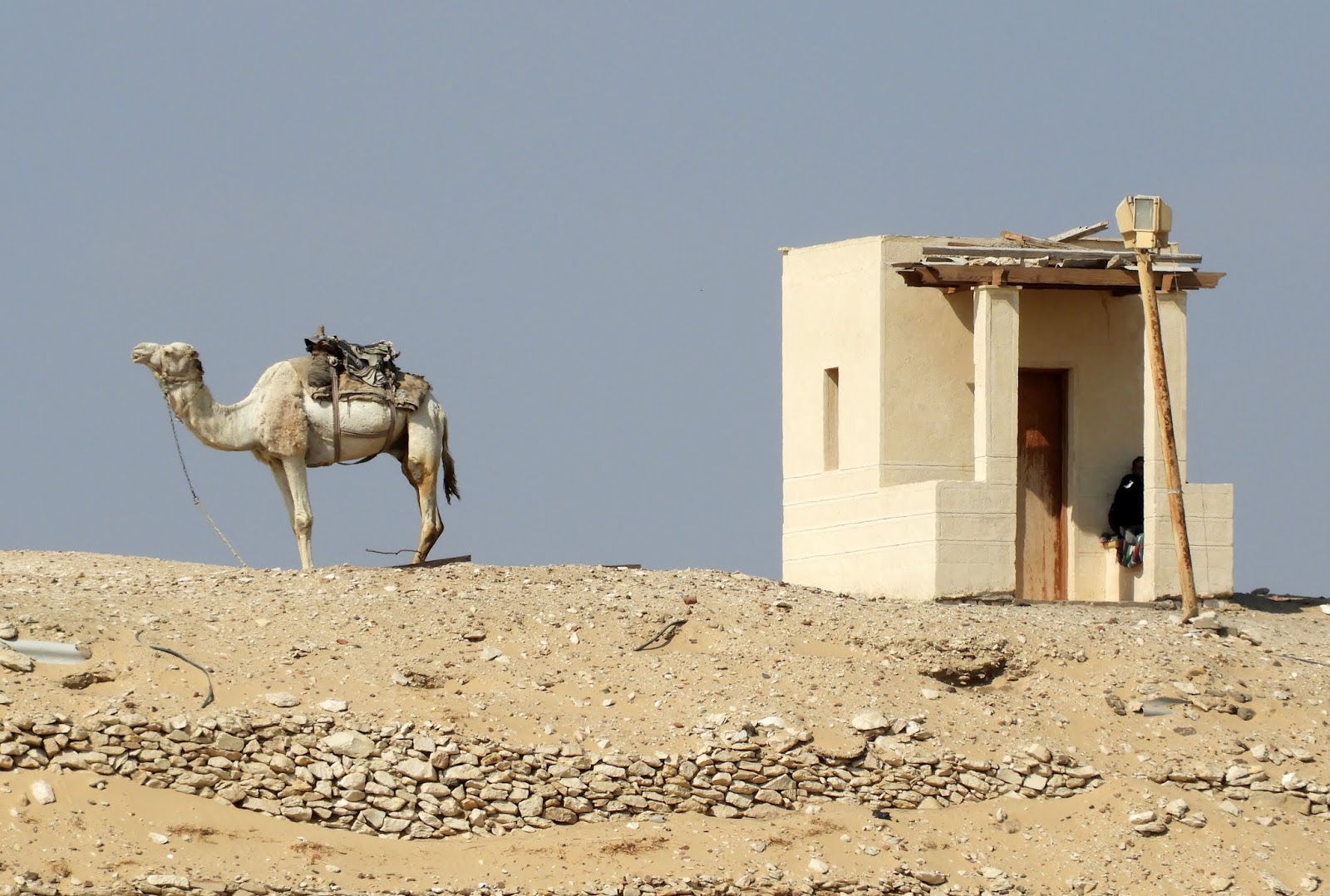
patient camel and hut near pyramids
Now, we're happily back, with a group of friends.  Tourism, however, isn't back, though it's growing again slowly.  We visited the Pyramids, Sakkara and Memphis today with far smaller crowds than we've seen in the past.  The Sound and Light show at the Pyramids, which used to have 3 performances a night for 300 people each, now has 1 show for only about 150 tourists.  This is a major hit to a country in which tourism used to make up 11% of the economy.
The Western Desert is closed to tourists right now, which is really unfortunate, since it is beautiful, so we are going to the Eastern Desert and the Red Sea after our cruise down the Nile from Aswan to Luxor.  Egypt is mostly desert; we don't want to miss experiencing it for a couple of days.  We are likely to do another trip to Egypt next year because the timing is very good, given the lack of swarms of tourists, and interest in visiting this remarkable country is growing again.
view of pyramids from our hotel room at night
Today, we spent the morning at the Great Pyramids, the place every world traveler wants to see.  It was a typically gorgeous Egyptian morning with the pyramids rising out of the desert landscape against a bright blue sky.  The 3 pyramids at Giza were constructed for the pharoah, his son and his grandson, each succeeding one slightly smaller than the Great Pyramid, to reflect the importance of the father.  The 3 very small pyramids were for the royal women--at least they got something, I suppose, which isn't saying much since the big buys wouldn't have been there without them.  There is still a lot of archaeological exploration going on here, now with high tech cameras and tools that are finding more chambers and passageways inside these enormous structures.
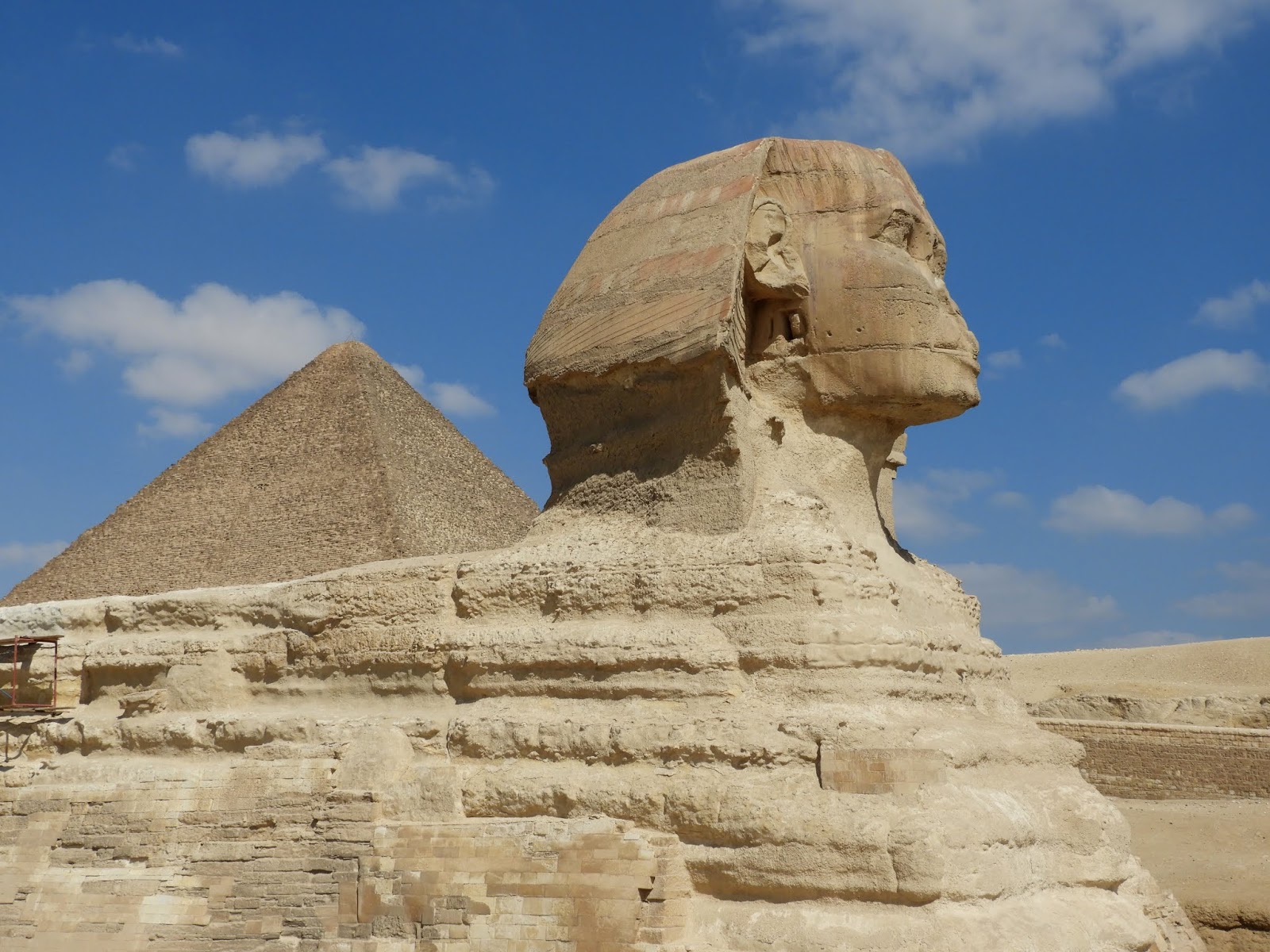
the Sphinx
The Sphinx sits below the pyramids, guarding what once was a temple in this huge burial complex.  It has lost its nose, reportedly to target practice launched by nineteenth century British soldiers.  Nonetheless, it is a stunning masterpiece of Egyptian artistry and technology.
40-ton block that is Ramses II, Memphis
We drove through the traffic and rapidly expanding city to the ancient capital of Memphis to see the second Sphinx and Ramses II's enormous statues of himself.  The largest statue was found face down in the sand, so is well-preserved.  Our guide told us that farmers are constantly finding more ancient buildings and statues, but don't want to notify the government because they fear the government will take away their land to protect the pharaonic legacy, with minimal compensation.
Nearby is Sakkara, with the Stepped Pyramid, the oldest of the pyramids.  A series of tombs with beautiful carved walls, brightly painted so long ago, is nearby.  We scooted, doubled over, down a long corridor into one of the tombs to see a sarcophagus, long ago robbed of its human and ornamental contents, and the hieroglyphics carved into the walls.
men in boat with hippos on wall of Sakkara tomb
Stepped Pyramid at Sakkara
Tomorrow, we will tour Cairo and get a briefing at the U.S. Embassy, so expect to learn much more about Egypt, ancient and modern.

Saturday, November 3, 2018

Northwestern Argentina--Salta and Cafayate

Rock formations outside Cafayate

We started our day with a flat tire—probably no surprise given the rocky road we traversed yesterday.  Cafayate has no Hertz office, no gas station that fixes tires and no tire store.  So, I called our travel agent who called Hertz who called someone in Cafayate who said he could help us get a new tire for our 160 mile drive to Salta.  When we pulled up to the repair shop, the guy Hertz called was waiting for us, so I called our travel agent, who talked to him in Spanish and off he went to get the replacement tire.  Two hours after we first attempted to leave, we were on the road to Salta, feeling much happier with 2 tires that held air.
red rocks near Cafayate
Cafayate is a small town, center of one of Argentina’s major wine regions.  It is a bit nondescript, but does have a wine museum and a pretty plaza lined with restaurants and a few shops. 
jumbled rocks and colors
The real lure of Cafayate is not just the fine wineries here and the beautiful wine hotel where we stayed last night, but also the spectacular drive between Cafayate and Salta.  I know I’ve used that word a lot in this part of the Andes, but it’s accurate, as the mountains and formations you drive through all over this region are truly stunning in their shapes, geology, massiveness and colors. 
This drive equals the others in making you marvel at what the earth has done to itself.  We drove through huge canyons and deep gorges, stopping to photograph the scenery.  When we bring a group here, we will try to get a naturalist/geologist to come with us to explain the breathtaking world we’ll drive through.
Patios del Cafayate, lovely wine hotel

Once back in Salta, we found our way through the traffic and potholes to the beautiful central plaza, but didn’t have time to do any sightseeing as we were already late, and couldn’t find a place to park anyway.  It was 2:30 and we were hungry, so when we did finally find a parking place, we were on the lookout for a café.  A woman beckoned us into her courtyard.  Inside, she had turned her small home into a restaurant with 5 tables in the former living room/kitchen and 1 table in the former interior courtyard, now the kitchen.
uplifted red rocks
They made space for us and brought us delicious empanadas.  We wanted water, so one of the boys serving patrons (probably a son) went off to the nearest store and bought a large bottle for us.
Of course, we needed the bano after a long drive.  The lady took us into the rest of her house, where her family lives, to use their bathroom.  But, first, she had to protect us from a very large and very old dog who only liked her and growled quietly all the time we were there.  The bathroom sink didn’t work, but everything else did, so we were happy even if we disturbed the dog’s rest.
House of Jasmine, our estancia hotel in Salta

Now we’re at the Salta airport waiting for our very delayed flight to Buenos Aires.  Of course, Aerolineas said the flight was on time until just about departure time, when they announced it would be 2 hours late.  Right now, the time we were supposed to leave, they’re boarding their earlier flight to BA, also 2 hours late.  Being on time is not a priority for Aerolineas, as we’ve found when we’ve flown them in the past.  It’s why I’ve decided never to trust a same-day connection to our flight home, even with 10 or 12 hours to do so.  We’ve had too many close calls and today we would have missed our flight home.  So, when we eventually get to Buenos Aires, we’ll spend what’s left of the night and leave tomorrow night for home.  We're excited to be staying once again at our favorite hotel in Buenos Aires, the Hub Porteno, a very small, beautiful hotel, with huge suite rooms on a quiet street in the Recoleta district.  We recommend it to everyone.
valley on the way to Salta


Thursday, November 1, 2018

Salta and its stunning province

21000 foot peaks above Cachi
Salta has been one of the places in Argentina we've always wanted to visit.  We drove to a lovely hacienda just outside Salta from Purmamarca and, after a long day, luxuriated in its peaceful grounds looking up to the towering mountains beyond.  On a walk around the hacienda, we saw many small owls, buhos, which are ground dwellers.  They are beautiful little creatures.
buho
Tomorrow, we'll visit the city of Salta before flying to Buenos Aires for one night and then returning home.  What a great trip this has been.  I'm sure we will be offering a variation of it to our fellow travelers soon.
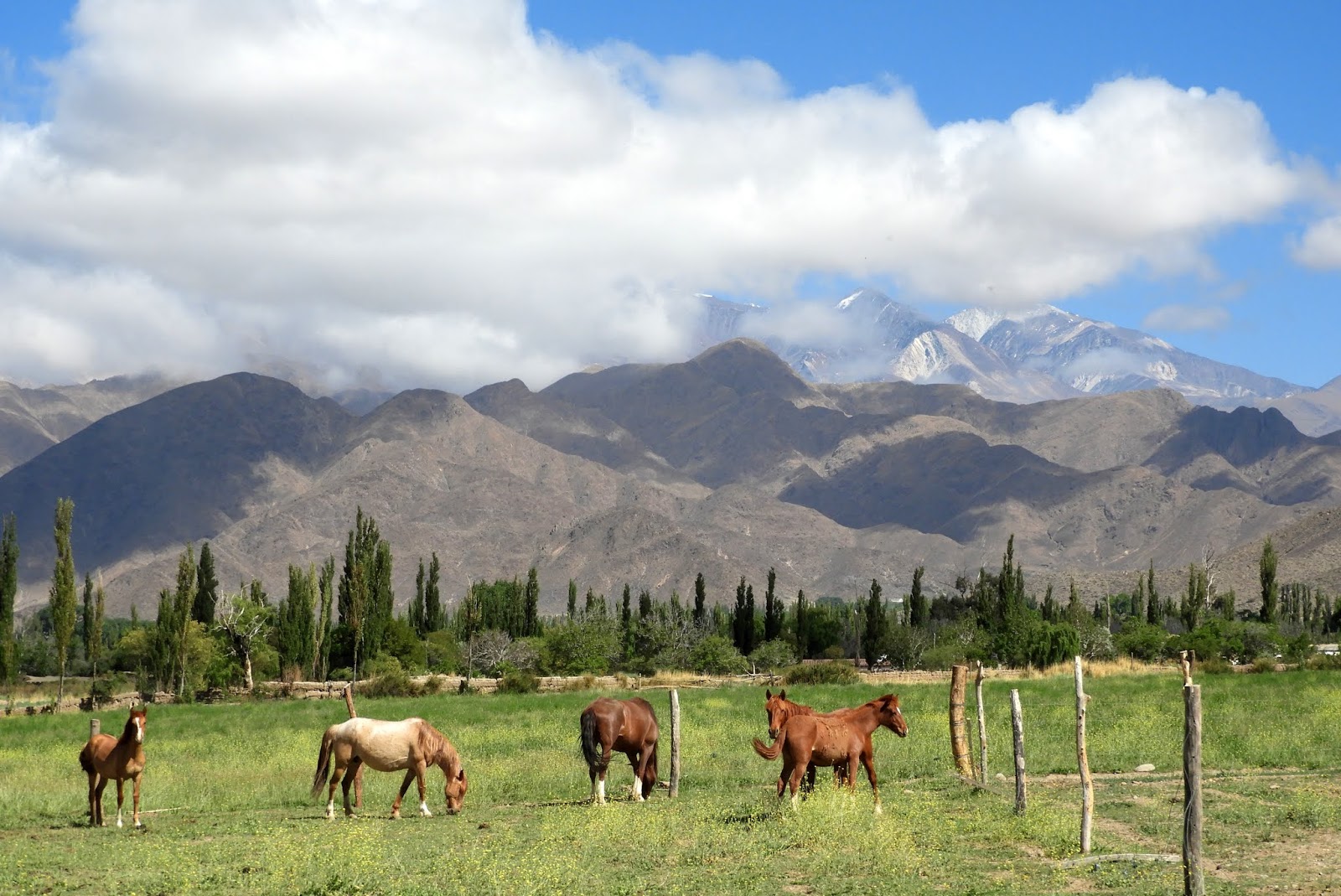
horses near Cachi
Yesterday, we drove to Cachi, a mountain town about 3 hours from Salta.  To get there, we drove up the Calchaqui Valley, and across the Lerma Valley, up and up and up a graveled road, rimmed by steep mountainsides and cliffs, around hairpin turns for miles and miles until we topped out about 11,500 feet and entered the Argentine altiplano, ringed by snow-capped peaks, many over 20,000 feet.  Late in the day, we reached Cachi and flopped into our hotel room in an old estancia in the most gorgeous setting, ready for some rest and good wine.
Cachi, like all the Andean villages we've visited and driven through on this trip, is an Indian town, rich in the culture of the Andes.  Tourists make day trips to Cachi from Salta, which would be a long day since you have to go both ways over this difficult road.  So, the town begins to move about 11:30 in the morning when the first tourist vans start to arrive.  It is very pretty and incredibly clean.  We wandered around before the tourists arrived and saw people sweeping the streets and shopkeepers and restaurant owners setting up for the visitors who have made their town quite prosperous.
In the area around Cachi, most of the homes used to be adobe.  Now, new homes of concrete or concrete block are being built, replacing the old adobe homes, which are given over to the animals.  Adobe walls line the dirt roads, but many are melting with each heavy rainfall, replaced by fence posts and wire.
old adobe house now used for animals
The area around Salta is big horse country.  Horses graze in the green grass next to every road, safely staked away from the traffic, and fill the fields around the houses.  Argentinians love polo and the horses reflect the importance of good breeding and good care to this sport.
new concrete house and fancy wall next to old adobe
Today, we left Cachi and drove down Highway 40, through the most amazing scenery.  The highway, itself, the major artery between Cachi and Cafayate, one of Argentina's wine regions, is butt-busting, bone-jarring, washboarded gravel for 140 kilometers of the 170 kilometers between Cachi and Cafayate.  It took us nearly 4 hours to negotiate the steep climbs, many washes and twisting turns, not getting out of third gear until the very end of the journey.
There are several wineries along the route, which is really surprising since hauling your wine to market must be a costly and jarring experience.  We drove for almost 3 hours before we found a small town that had a restaurant.  Otherwise, until the last 40 kilometers, there was nothing but a few adobe houses, 2 closed wineries, almost no cars, and lots of dust.  And, the most spectacular scenery.
uplifted rocks between Cachi and Cafayate
Rocks of pink, red, tan and gray hues have been thrust up in huge plates, standing almost straight.  They are bent and twisted into amazing shapes, thrusting themselves high up into the blue, blue sky.  The mountains rise above this fantastic array of giant shapes for mile after mile as the road winds up and over and through the rocks and ridges and dry river beds.  I would have taken many photos, but that would have added hours to our day and, besides, I had to focus on driving on this difficult and wondrous road cum highway.
red rock mountains along highway 40
Leaving the village where we had lunch, we picked up a young girl who was hitchhiking home, perhaps after school or work.  But, home was 35 kilometers up the road, so I hope she didn't have to do this twice every day.  Our Spanish isn't good enough for much communication and she spoke no English, but we were able to get her home nonetheless.  She tolerated my stops to take photos.
Tonight, we're staying at a beautiful wine estate in Cafayate before heading to Salta tomorrow.
wash and rocks along highway 40

Tuesday, October 30, 2018

Purmamarca, Argentina--what a setting!


Purmamarca, Argentina

Purmamarca, Argentina is an Indian village in one of the most spectacular settings in the Andes.  More on that in a minute.  It's streets are rocky and dusty, lined with old adobe or rock buildings full of shops and homes.  There isn't any sign of wealth here, but lots of creativity, music and sense of community, where everyone knows everyone else.
The town has a busy and colorful Indian market surrounding the town plaza and filling the streets that spread out from the square. 
Mid-day and late into the afternoon, tourists shop for the brightly colored handicrafts in the outdoor market and in the shops lining the streets.  We did not meet any other American tourists; they’re mostly Argentinians with some Europeans making their way to this remote area.  Consequently, not too many people speak English, but we were able to get by with our miserable Spanish because everyone was so kind.
market stall with dog

Yesterday afternoon, after waiting too many hours for our rental car to arrive in Purmamarca, we drove up the next valley over to Humahuaca, another Indian town.  We did not think it was worth the visit, though the valley itself was colorful and beautiful.  Purmamarca’s Indian market is much bigger and livelier and the magnificence of the mountains and the fascinating geology make it the more interesting place to visit.

Purmamarca has many restaurants, all with live music most of the day.  We went to one last night that was particularly popular, probably because the musician was exceptionally charming with a beautiful voice.  The diners loved him.
Today, we hiked about 3 ½ miles up a jeep road in the valley just behind Purmamarca, to the end of the road and a bit beyond, up a dry, pink wash.  It is hard to describe the beauty of this place.  The wildly contorted rocks are a giant painter’s palate, with pink, red, green, orange and white masses of color as you walk up the valley.  You can see similar rock formations just walking around the town, but nothing like the steep valley behind the village.  Several softer formations are heavily eroded into pinnacles and spikes and deep mini-gorges that catch the light and shadows.
Selena, the llama
There are a number of hotels in Purmamarca, none that are luxury level.  Ours had a pretty garden with adequate rooms and towels that had seen better days years ago.  Its biggest attraction is Selena, a sweet llama who resides at the hotel and keeps the grass mowed.  After many soft conversations, she finally came over to sniff my hand, which she found less than appealing.  Nevertheless, she kept sniffing and let me pet her ever so carefully for a split second.

I think I will let the photos describe this area because words can’t.  Not that the photos really show you the depth of the colors, but you’ll get the idea.


Purmamarca street and mountains beyond