Thursday, September 12, 2019

With my granddaughter--Masai Mara to the Serengeti

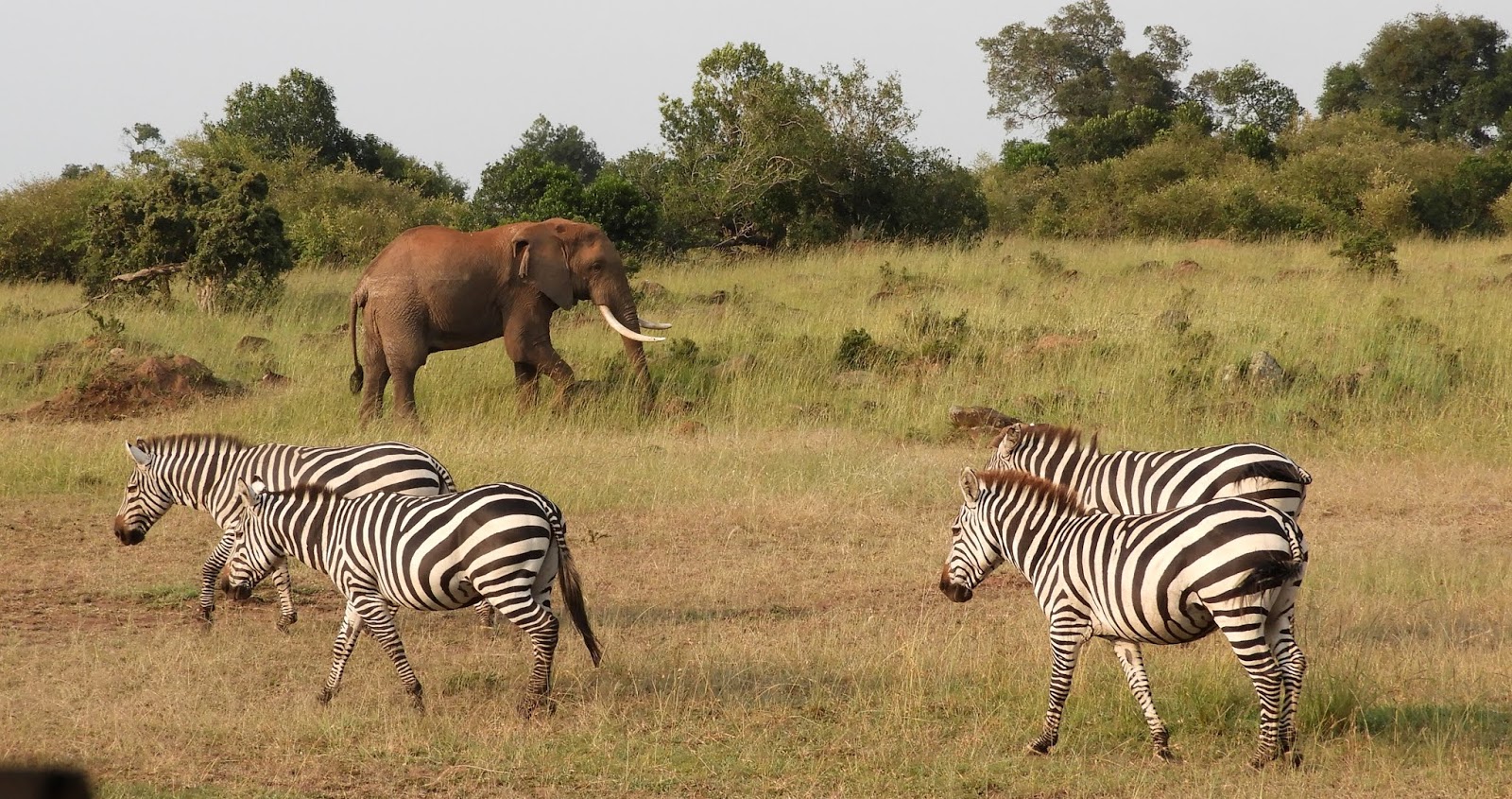
zebras and elephant at sunset

As my granddaughter and I drove to the air strip near Karen Blixen Camp in Kenya's Masai Mara Reserve, we saw literally thousands of zebra, more than I have ever seen before.  Babies were abundant, so, if the next rainy season is good, there will be many thousands more.  I think we saw at least 10,000 zebra during our 3 days in Masai Mara, stretching as far as the eye could see in massive herds.  The wildebeest with them also number in the many thousands, probably at least as many of them as zebra.  
herd of wildebeest
Instead of flying back to Nairobi, we took a bush plane to a town in Western Kenya where a bus met us to drive to the border between Kenya and Tanzania.  The driver shepherded us through customs and immigration on both sides of the border, a process that took about an hour.  From the border, we drove another 10 minutes to the Tarime airstrip in Tanzania where our bush plane to the Serengeti’s Seronera airstrip awaited us.  This is a much better route than flying or driving back to Nairobi, then flying to Kilimanjaro Airport in Tanzania where clearing customs can mean long lines, before flying on to one of the Serengeti airstrips.  
our plane to the Seronera

It’s very easy to fly around East Africa.  The airlines are set up to manage multiple landings at the many airstrips all over Kenya and Tanzania.  The flight departures and arrivals depend on how many people are going where and how many airstrips each flight must visit.  It’s quite a logistical marvel.  The airlines notify each passenger’s travel agency and camp the night before a departure to let them (and you) know what time to be at the airstrip.  Since there is no customs or security, the plane merely lands, loads you and your luggage—small bags only—and takes off.  The pilots are excellent since they take off and land on dirt or grass runways many times a day.  They can find a tiny airstrip in the midst of the large savannah or forest, distinguish it from dozens of others that look just like it, and deposit you where you need to go.
Since the majority of the zebra and wildebeest had already moved north by late July, the remaining animals in the central Serengeti (Seronera area) had a little more space and grass. 
Thompson's gazelle
I have never seen as many of the beautiful, small Thompson’s gazelles as we did our first afternoon.  We watched a lioness eat a Thompson’s gazelle deep inside a bush, perhaps hiding it from the rest of her pride, and a large male lion snoozing under an acacia tree.  We finally found our leopard, beautifully camouflaged beneath an aloe vera cactus high up on a rock, sleeping off her recent meal.
View from Asanja Moru tented camp
Our first camp in Tanzania was Asanja Africa Moru Tented Camp, far out in the bush in the central Serengeti.  This is much more rustic than Karen Blixen, but still quite luxurious, given its location.  They have to haul their water from Seronera, so work hard to conserve water.  Their electricity is all solar.  The large tents face the golden hillside covered with acacias and wide open to any animal that wanders by.  At night, as in most camps, you need an escort to go to and from dinner in the main lodge, which is also open to the savannah and the stars.  There are no noises except the sounds of the animals and the wind blowing the canvas flaps of the tents.  As with most tented camps (which I much refer to the lodges and hotels), there are no windows, just large screened openings with flaps that can be lowered at night, via zippers, if it’s cold.  The entrance also zips and has canvas flaps.  A curtain separates the bathroom from the sleeping area which has large, comfortable beds and soft fleece robes.  

can you find the leopard sleeping behind the aloe vera?
I have always seen leopards in the Seronera area of the Serengeti and this time was no different.  More on these beautiful cats in my next blog.


Wednesday, September 11, 2019

Nairobi's great places for kids

Sheldrick's elephant orphanage--this 1 year old LOVED the mud
Last year, I took my 10-year-old grandson to East Africa, Kenya and Tanzania, so he could learn about a different part of the world than his California and, now, North Carolina homes and see the magnificent animals that populate the East African savannah.
baby eager for its bottle of formula
This summer, I was back in Kenya with my 9-year-old granddaughter for the same reasons.  We spent 2 days in Nairobi, visiting Sheldrick’s Elephant Orphanage, where orphaned and often injured baby elephants are cared for until they are slowly introduced back into the wild.  This is a highlight for any child, watching the keepers feed enormous bottles of baby formula to the eager babies (up to 3 years of age) and the babies’ frolics in the mud bath that is maintained for their play (the mud also keeps them cool in the heat of summer).
feeding the babies at Sheldrick's
Most of the babies have been found in one of Kenya’s many game reserves, wandering alone.  An elephant herd will try to protect an orphaned baby, but no other female will feed it, so unless it has learned to eat grass and foliage, it will starve.  Sheldrick’s has found that regular baby formula works best for these huge infants.  Slowly, they learn to eat leaves and grass.  When they are 3 and healthy, they are taken to Sheldrick’s sanctuary in one of the reserves and reintroduced to wild elephant life over 5 years.  They gradually go out to meet elephant herds until one admits the young elephant into its family life.  At that point, they are self-sufficient in the midst of the herd and wild once again. 
We also visited the Bomas, an outdoor museum with typical homes and enclosures used by most of Kenya’s tribes.  Some are thatched huts and others are mud and thatch.  There are about 20 different enclosures that show how people live in the countryside.  Both my grandchildren loved ducking into the huts and exploring the different ways people build houses.
a family compound at the Bomas, Nairobi
There is also a cultural performance showing a variety of tribal dances.  Almost all the visitors are Kenyan school children, dressed in their various uniforms and enchanted with one another.  Last year, the program ended with exceptional Masai dancing, which features incredible jumping by the men, and a superb acrobatic exhibition.  This year, the Masai dancing was lackluster and there were no acrobats.  I would not recommend this cultural show as it was very disappointing this year, though I do think the Bomas are worth a visit.
There is also a giraffe sanctuary, which you must visit mid-day when they're feeding the rescued giraffes and several museums.  For kids, a shorter day is better because they (and you) will be tired after a long trip.
Sheldrick's babies at play

Going on safari with a child--10 tips for a wonderful trip

leopard and cub in the Serengeti
Last year, I took my 10-year-old grandson to Kenya and Tanzania.  We spent 12 days in tented camps and a lodge (at the Ngorongoro Crater), in the Kenyan Highlands, Tanzania's fabulous Serengeti and Ngorongoro Crater. 
This summer, I took my 9-year-old granddaughter on a similar trip, but visited Kenya's magnificent Masai Mara rather than the Highlands, which did not have the rich variety of animals that the Masai Mara has.
our tent in Masai Mara
 These two trips have brought me so much joy--traveling with one grandchild by myself, seeing an extraordinary part of the world with each of them.  I feel so incredibly lucky.
I learned a lot about traveling on safari with children, so thought I would share some of my lessons learned.  My granddaughter is a devoted animal-lover who quickly learned the names of many of the birds and all of the  animals we saw.  She loved being an animal spotter, became quite fascinated with the various carcasses provided by the large predators, and enjoyed the scenery. 
silver-backed jackal, a favorite on both trips
My grandson was deep into book 7 of the Harry Potter series and did not want to put his books down, even in the back of a bouncing Land Cruiser.  He loved seeing and photographing all the animals we saw, but was not as interested in spotting them as his sister.
Safaris can involve long drives between camps, sometimes without seeing a lot of animals.  To get around quickly, we also had quite a few flights on the tiny planes that hop around the game parks of East Africa, landing at small airstrips. 
All of this is worth it for the incredible experience of seeing such beautiful animals, some in very large numbers.  I am going to do several more blogs about what my granddaughter and I did and saw this summer, but will start with some suggestions on how to travel happily with a child.
We started both trips with 2 nights in Nairobi since our flights arrived in the evening.  That gave us a chance to have a lazy morning after a long day of travel, visit some of the fun sites for kids (see my next blogs) in Nairobi, and relax in the late afternoon.
a matriarch and her family
1.  Reserve your own vehicle and driver/guide, just for your family.  
I've been in Africa and on safari many times.  The most important thing to me is to have our own vehicle and driver/guide.  In East Africa, we always reserve a pop-top Land Cruiser that lets you stand up, look for game and take photos while having a roof to protect you from too much sun (Southern Africa more often has open vehicles, but you can usually still reserve your own).  With kids, the flexibility of having your own vehicle and guide is a huge bonus because you can decide when and where you want to go and how long you want to stay out looking for animals.
2.  Do not overdo the game drives.  
A full day game drive is a lot for a child.  So, I made sure we did not have 2 long days in a row.  We would spend one full day seeing animals, usually the day we changed camps, and break up the next day with early morning and late afternoon drives, enjoying a long, relaxing break with lunch in camp and time in our tents in between.  That way, kids can take a nap or read their books or play games on their tablets and relax.  I think this is really important since the drives can be very tiring.  Tired children cannot enjoy the experience.
mom and baby--all babies are a big hit
3.  Be very flexible.
My grandson wanted to read Harry Potter during our longer drives and I wanted him to watch for animals.  When I finally figured out that he would enjoy the trip much more if I were just more flexible, we both had a lot more fun.  We worked out a system where he would get 30 to 60 minutes to read while we were driving, but not when we stopped to see animals, and then he would spend 30 minutes spotting animals as we drove.  In camp, he got to do just what he wanted while I edited photos and wrote my blogs.  We both really liked this arrangement.
4.  Spend at least 2 nights at each stop.  Consider spending 3 nights at 1 or 2 stops.  This lets you have a place to return to for mid-day time rest and relaxation.  
On our trips anywhere, we always stay at least 2 nights in one place so we don't have to pack and move every day.  I think this is particularly important when you're on safari, and even more important with a child who needs a place to return to.  With my grandchildren, I spent 3 nights at our first camp.  We all liked coming back to our tent and our beds and our things for a couple of nights.  The rest of the time, we spent 2 nights at each camp.  If we were taking a longer trip, I would add a third night at one of the camps.
waterbuck right outside our room at the Ngogongoro Crater
5.  Don't make the trip too long.  Our trips were 12 days, including travel days.  This was plenty for my grandchildren.  Much as they loved the animals and enjoyed the tents, the guides, the different culture and the experience of being in Africa, 10 days of seeing lots of animals was plenty.  They were ready to go home when it was time to leave (and they're equally ready to go on another adventure).
6.  Take a tablet or similar for each child, loaded with several books they really want to read and a couple of games they love to play.  
My grandson and I had one very delayed flight from the Kenyan Highlands to Nairobi, where we were to catch a bush flight to the Serengeti.  Fortunately, we were at a small airport that had chairs and a little restaurant (with a grilled cheese sandwich).  The airstrips generally have no place to wait except in your vehicle--no guide should ever leave until your plane is in the air.  My grandson had his tablet with his Harry Potter books loaded onto it and some games.  He was perfectly happy curled up in a chair reading and occasionally eating while we waited 4 hours for our plane.  Fortunately, the local airlines going to the game parks (which are excellent) wait for delayed passengers.
zebras are another favorite
7.  A travel pillow in the vehicle can provide a more comfortable nap for a tired child.  
We took small travel pillows which made my grandchildren very happy, along with my fleece jacket draped cozily over their shoulders.
8.  Look for camps that are child-friendly, but don't believe everything they say.  
I took my grandson to a child-friendly camp in the Kenyan Highlands because they advertised lots of activities for kids and the owners have 2 young boys of their own.  The activities were fun when they were available, but required an iron nerve from me because they were a bit risky and under-supervised.  The boys did not always want my grandson to do things with them.  With my granddaughter, our camp in Masai Mara had crafts, walks and games for kids, which she really enjoyed.  So, check them out in the reviews before you reserve.
who wouldn't love a warthog?
9.  Take lightweight binoculars and a simple camera for children.  I found a Canon camera, very simple and lightweight, with a 40x zoom, which was great for photographing animals.
Both my grandchildren are very proud of their photos.  We put them into photobooks and they look at them constantly.  Having their own binoculars gives them the chance to watch all the animals in all their daily activities and lets you enjoy your own viewing with your own binoculars.
10.  Be extremely careful about what you eat and drink.
There's nothing that will destroy a trip faster than being sick.  I was extremely careful about what my grandchildren ate and drank.  Only bottled water to drink and brush teeth.  Only cooked food and peeled fruits and vegetables.  No food at all that might have been washed in unsafe water.  Many camps provide purified water for filling water bottles, which should be fine, but I strongly recommend against eating fresh, unpeeled fruits and vegetables and salads.  And, just in case, take some child-strength Imodium or prescription to relieve the miserable symptoms.  Better not to get sick in the first place.  We returned healthy and happy.
I think safaris can be wonderful for adults and children if you plan carefully and expect to be very flexible.  My grandchildren and I will remember our trips to Africa with so much enthusiasm and pleasure. 
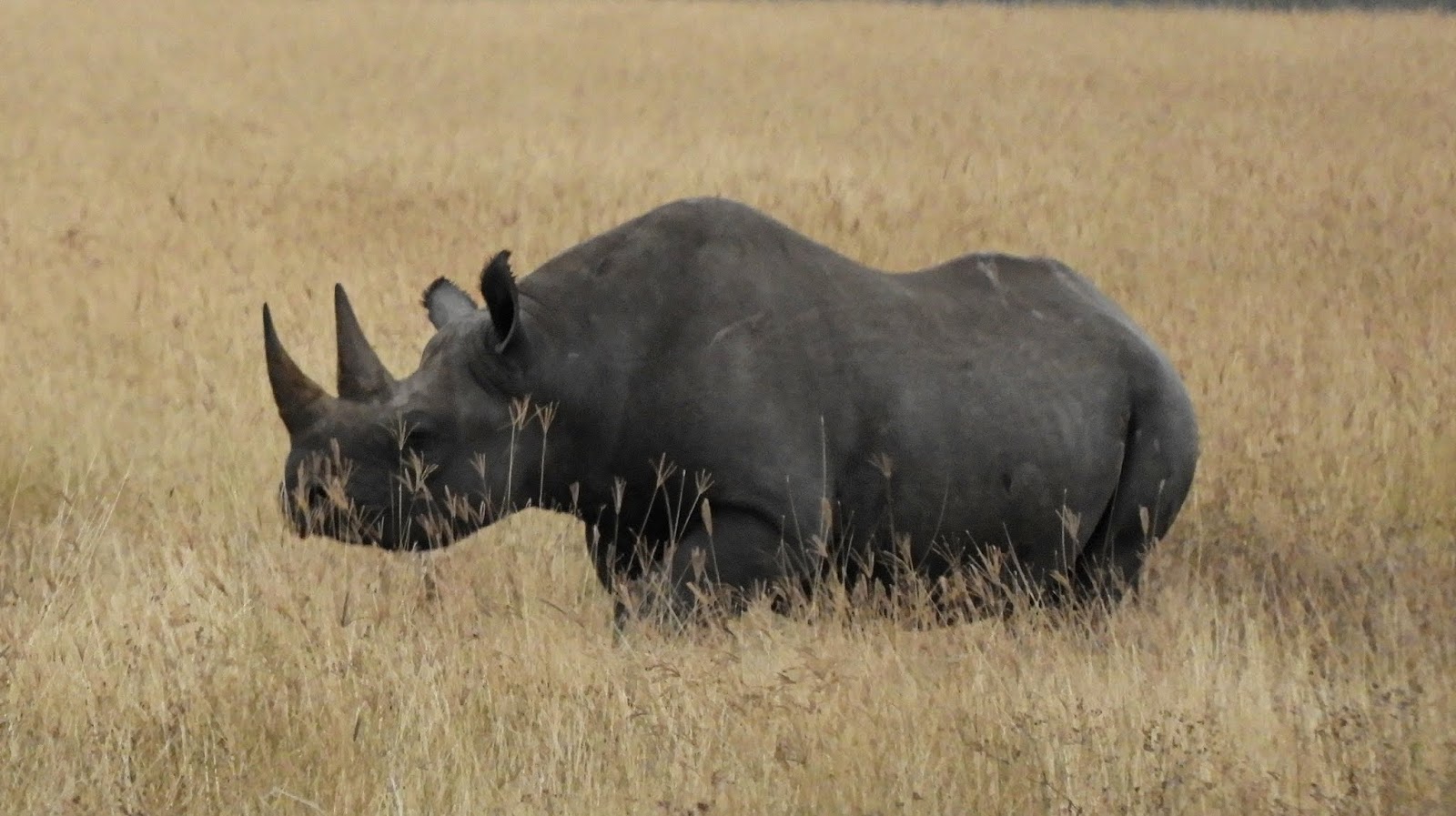
the extremely rare black rhino--meandering across the Crater

Friday, April 5, 2019

Nazareth and Jerusalem

Dome of the Rock, Jerusalem

Nazareth, the town where the Angel Gabriel announced to Mary that she was to give birth to a baby, is called the Arab capital of Israel with a majority of Arab Israelis living there.  The Old City is worth a visit to wander the alleyways of its bazaar and enjoy some good Arab food.  Obviously, the city is a beacon for Christians anxious to visit the various churches dedicated to Mary and the Annunciation.  One small excavation shows the kind of stone houses that were common 2000 years ago, at the time Mary, Joseph and Jesus lived.
doorway in Nazareth

Continuing on to Jerusalem, we wanted to visit Yad Vashem again, the incredible museum devoted to the Holocaust and the remembrance of the 6 million Jews who died in the Holocaust.  We had a private guided tour, so learned much more than we had during our first visit. 
Nazareth houses from the time of Jesus
Importantly, non-Jews who helped Jews escape the Nazis, called the Righteous of the Nations, are honored here also, with trees planted in their names.  Originally, the planners thought there would be several hundred of these women and men, but there have been 27,000 identified so far.  Their stories testify to individual and communal courage and action to do what is right in a time of terror and hate and total brutality.  There was one town in southern France, with 5000 inhabitants, in which many families hid Jews escaping the Nazis.  Everyone in town knew this and not one person ever betrayed them.  The town and all its people are honored.
Our guide was a settler from New Jersey with 7 children.  She and her family moved to Israel 13 years ago to be part of building a Jewish homeland.  They are Orthodox Jews who believe, as our guide at the kibbutz did, that God gave the Jews this promised land and they must love it and care for it.  Her desire is to live in harmony with the Palestinians, which, she said, is what most Jews and Palestinians.  What she did not say was that a Palestinian state would be part of this peaceful coexistence.  She has a Ph.D in English Literature and teaches in Israel’s equivalent of the community college system which gives her time for her passion—learning the stories of the survivors of the Holocaust.
Yad Vashem, an arrow through the heart of Mt. Herzl
She was exceptional.  She knows the names of each survivor and their stories, and still she is learning more.  The stories are horrific.  Watching the survivors tell their stories on video is wrenching as they struggle 70 years later to recount something so horrible that it defies words. 
sculpture outside Children's Memorial
Early in the War, before the Nazi death camps were built, the Nazis had squads of soldiers whose job was to murder all the Jews the army found as they conquered across Europe.  Initially, this was done by having the Jews dig pits, lining them up along the edges and shooting them so they would fall into the pit.  Wave after wave of men, women and children were murdered this way.  One survivor, in a video, told of being in the line about to be shot.  Just before the shooting began, his grandfather pushed him into the pit on top of all the bodies already lying there so that he would have a chance to live.  After all the killing was done and it was dark, this 16-year-old tried to move.  He felt a hand grab his leg.  There was one other boy who had also survived the slaughter unhurt.  Somehow the 2 of them managed to free themselves from the mass of corpses and escape into the forest.  I do not know the courage it takes to survive such horror and still be able to build a life for yourself, creating a new family when all your original family is dead.
arched passageway, Jerusalem
The Children’s Memorial at Yad Vashem is a quiet place for contemplation.  The architect designed a building that is dark inside except for 5 candles that are always burning, reflected in thousands of mirrors so that it looks like there are thousands of candles honoring the 1.5 million children who were murdered in the Holocaust.  Their photos, or as many as have been found, line the walls while their names, ages and birthplaces are continuously read.  It is a place of such sadness, but also with so much love for the lost children.  Israel is determined that they will be remembered.
Jerusalem is a limestone city, with new buildings required to be built of or faced with limestone.  So, it shimmers, even in the rain, and blends ancient and modern structures.  The Old City has 4 quarters, Jewish, Muslim, Christian and Armenian.  The Western Wall is in the Jewish Quarter, with security checks required to get in.  Above the Wall on the Temple Mount are sites sacred to Jews, Muslims and Christians, with access carefully guarded.  Both Jewish and Muslim quarters have busy bazaars full of souvenir shops and stalls selling produce, meat, and spices.  The city’s layers of history play out even today in religion, politics and, too often, enmity.  But, in the bazaar, everyone mixes, selling, shopping, talking.
Jaffa Gate, Jerusalem


Tuesday, April 2, 2019

Around the Sea of Galilee


Beit She'an zebra mosaic
Israel is experiencing an unusual amount of rain this season, so the hills and fields around the Sea of Galilee are covered with wildflowers, white and yellow daisies and brilliant red poppies.  The grass is tall and bright green, especially on the Golan Heights which rise above the Sea on its east side.  I wish I could have photographed these hills, but it was raining pretty constantly while we were in the Galilee area.
Sea of  Galilee
Beit She'an temple columns
We stayed in Tiberias, the largest city in the area, overlooking the Sea of Galilee (which is only 1/3 the size of Lake Tahoe).  This is an area rich in Biblical history and also in kibbutzim, the collective farms that were a key part of building Israeli culture and society.  I did a blog yesterday on the kibbutz we visited.
There is also Israel's best Roman ruin, Beit She'an, just south of the Sea.  It is worth a visit, mostly for its beautiful mosaics.  As in Caesarea, these mosaics need to be protected.  There is some restoration work going on at Beit She'an, but it needs a lot more resources to protect it.  The stones in the mosaics are quite large, which means they are Roman rather than Byzantine.  
Beit She'an's central road
The site is a tell, a large mound or hill created from the construction of cities on top of older cities.  The Beit She'an tell excavations show at least 20 cities built one on top of the other, starting in the Late Neolithic period.  Archaeologists believe the site has been occupied for about 8000 years.  Nearby is another large tell which has yet to be excavated.
beautiful mosaic floor like a carpet
The Sea of Galilee is a major source of water for agriculture and domestic use in Israel.  It rises and falls with the rains and some snow from Mt. Hebron, to its northeast, so Israelis watch it closely.  The two days we were there, it rained pretty constantly, so good for the water supply.  The Sea was too choppy for tourist boats.  The shores of the Sea are mostly swampy, though our hotel had created a small beach for guests to use in warmer weather.
Below are some of my favorite mosaics.

inscription
fish mosaic

lion mosaic

Monday, April 1, 2019

Visiting a fascinating "religious" kibbutz in the Jordan Valley

housing at Sde Eliyahu
Yesterday, we visited a "religious" kibbutz, Sde Eliyahu, just south of the Sea of Galilee in the Jordan Valley, and spent a fascinating 3 hours there with Benny, an "observant" Jew from New Jersey who has lived on the kibbutz for 40 years, since he was 25.  He explained his own life and the workings of the kibbutz, both politically and economically.  There are kibbutzim that are religious or "observant" (we would call Orthodox, but Benny doesn't like that term) and others that are much more casual about religious practices.
date palm orchard
Sde Eliyahu was started by a group of teenagers from Europe in 1937 who had managed to get by the British blockade of Jewish immigrants.  In order to start their own religious community as a kibbutz, they had to build a stockade and a tower--sufficient to qualify the land as theirs and to keep the British from kicking them out.  They claimed the Bedouin were not there, and they probably weren't right then since they moved around with their flocks.  But, the Bedouin returned to find a small Jewish establishment on lands they had always used.
kindergarten play yard
There was already one small "religious" kibbutz in the area; soon there were three.  All started the same way, with a couple of teenagers milking a cow and raising some chickens and probably planting a little wheat along with some vegetables.  Soon, someone started making cheese and butter with the milk, bread from the wheat, and so on, until they had established a modicum of self-sufficiency.  Meanwhile, they built rudimentary housing for themselves and began to plan a future with families, homes, schools, a clinic and a multi-faceted agricultural complex of fields and orchards.
dining hall and "commons"
Sde Eliyahu now has 700 residents, 280 of whom are "members" who can vote and make all the decisions for the entire community.  For example, there was only 1 phone for many years and the members decided no one should have a private phone.  Same with televisions.  But, of course, mobile phones and the internet came along and now everyone has a cell phone, a computer and a TV.  The members decided that no one would have a car; residents can rent one from the kibbutz' pool of cars.  Houses are all 1100 square feet.  Within those external walls, a family can do whatever it wants in terms of interior design and furnishings.  It is a bit less regimented now, but the kids still find it too restrictive and most are moving away when they reach 18.  This is a big problem for the future of the kibbutz, but, so far, the members have held to their structure despite the desire of young people for more individual choice.
harvesting carrots
We visited the primary school which has a schoolyard literally full of discarded stuff.  As a former school board member, I looked at it and saw enraged parents and lawsuits resulting from kids getting hurt on all the junk.  But, the kibbutz thinks the mass of stuff encourages the children to be creative, trying out all kinds of inventions and stories supported by the old chairs, wastebaskets, mattresses, etc. that fill the schoolyard.  They are probably right.  And parents probably can't successfully sue the kibbutz members if their child gets hurt.
This kibbutz is partly organic.  They ship produce to Europe, which has much stricter rules about what can be used on fruits, vegetables and animals than the US does.  They have fought insect pests by finding and now raising the predators who destroy the pests that destroy the crops.  One key "good" insect is the red spider mite, which they grow in large greenhouses.  Once the "bad" pests have all been destroyed, the spider mite starves to death, so does not become a nuisance itself.  To keep the population available for killing the harmful insects, the kibbutz also raises some of the damaging bugs to feed to the spider mites and other predators so they can maintain a population of them.
greenhouses (hundreds of them) for growing insects and crops
They also raise bumblebees.  These bees are good pollinators and don't suffer from hive collapse.  They don't make honey, so have to be fed, but they pollinate 30% more flowers than a human pollinator (which the kibbutz used in the past) in the same amount of time.  The bumblebees are raised in the now unused bomb shelters on the kibbutz which provide an even temperature and clean environment.
The kibbutz has a dairy, olive and date palm orchards, fields of wheat, greenhouses of herbs and vegetables, feed corn for the dairy cows, reservoirs full of tilapia and carp, fruit trees, and so much more.  They make their own herbs and spices to sell to tourists right on the kibbutz, in large, long warehouses with cleaners, driers and packagers.  The olives go to a central processing plant owned by all the kibbutzim in the area.
Everyone who wants to live on the kibbutz and eventually become a member (a 3 year wait) has the opportunity to work in all the many units of the operation.  The members vote on whether to invite someone to join them.
fish farm
Everything is run by committees, with all decisions eventually coming back to the members.  It sounds like these weekly meetings can go on a long time as everyone, including non-members, has the opportunity to voice an opinion, without time limits.
Benny talked to us about his love for this land, how he gets a thrill every time he drives down off the hills above the Jordan Valley and sees his kibbutz with its fields and orchards.  He believes God gave Jews this land and that it is their responsibility to use it well and to take care of it.  He raised his 6 children on this kibbutz (none will remain there) and has held most of the leadership posts in the community, currently being the Fire Chief.
bumblebees in hive
No one earns a salary, but everyone gets a monthly stipend of about $900 (for people without kids at home--families with young children get more) per month.  Bennie saves his money for his twice a year visit to his elderly father in New Jersey.  Housing, food in the dining room (a huge cafeteria), health care, education and all basic needs are met by the kibbutz.  Only about 2% of Israelis now live on kibbutzim.  For our host, this is the life he chose and the life he cherishes.

Israel's Mediterranean coast

mosaic from Roman villa at Caesarea
Saturday morning, we left our hotel in Amman at the awful hour of 3:30 a.m. because the airlines require you to be at the airport 3 hours before flight departure times.  Which is quite ridiculous since you spend 2 1/2 of those 3 hours sitting around wishing you were still asleep. 
Caesarea amphitheater
We arrived in Tel Aviv at 7:30 a.m., picked up our rental car and headed north.  Our first stop was at Caesarea, a Roman ruin right on the Mediterranean.  King Herod decided to build a port here in the first century BC to encourage trade throughout the Roman Empire.  He had 2 large breakwaters built to enclose a harbor and added a typical Roman city, complete with a hippodrome for chariot races and a theater.  A prosperous city grew up around the port, but suffered many wars and, ultimately, collapse from war and earthquake.
view of Haifa from Mt. Carmel
I first visited Caesarea more than 3 decades ago, with my kids, and loved it for its history, beautiful mosaics, fallen columns and spectacular setting, so I was looking forward to a new look.  There has been a lot of restoration over the last 30 years, not much of it well done.  The worst part is that the area has become almost a low-end theme park, with shops and cafes filling up a big part of the ruins and extending out onto the old Roman breakwater.  The reconstruction of the hippodrome and theater make them look like like faux ruins, with too much bright limestone rock used to fill in the holes left by cannon balls, fire and earthquake.  The mosaics are still beautiful, but in grave need of protection.  The movie that is supposed to give you a bit of the history of the site is pretty bad, with too much noise and zinging objects to be of much interest, though it does give you a small idea of the history.  I don't think I can recommend a visit to Caesarea when there are better options in Israel (more on that in another blog).
Bahai shrine and garden, Haifa
olives in the Acre bazaar
Onward to Haifa, a major Israeli port on the Mediterranean.  It has been a port and fishing village (no longer a village, but Israel's third largest city) for more than 3000 years.  The big attraction is the Bahai Shrine and gardens on the slopes of Mt. Carmel.  We stopped to visit and to climb Mt. Carmel, which is actually a long walk up a steep hill on a sidewalk that has increasingly impressive views of the harbor the higher you climb.  If you love gardens or are a Bahai, this is worth a visit.  But, I wouldn't go out of my way to see it otherwise.
old city wall, Acre
Acre was our last stop before driving east across Israel to the Sea of Galilee, our base for the next 2 days.  The Old City is right on the Mediterranean and has a busy Arab bazaar full of shops plus a huge Crusader Castle from the 11th century.  We enjoyed our stroll through the alleyways of the Arab quarter until a heavy rainstorm drove us off.  Some of the old castle walls are in the middle of the bay, bashed on our visit by waves and foam.  Fishing boats fill the harbor, so clearly this is still an important part of the economy.  We watched a tourist boat circling around inside the breakwater with partiers on board.  It was too rough to go out of this small area in a little boat. 
fragment of castle in the midst of waves